If you’ve ever worked on something you’re proud of: a gadget you developed with in your home, a brand name you brainstormed for weeks, or a book draft you keep coming back to, you’ve probably hit that moment where you ask: “How do I protect this?”
And somewhere in the answers, these three words pop up: patent, copyright, trademark.
On paper, they look like neat legal boxes. In real life, they’re messy. I’ve lost count of how many times people have mixed them up, sometimes using them as if they were the same thing. I get why: the boundaries aren’t always obvious, and most explanations online are just dictionary definitions. That’s not much help when you actually need to decide which one applies to your situation.
So, let’s ditch the jargon and talk about how they really work, especially in India, but also how they compare globally.
The Quick Way to Think About It
When I explain this to students or startup founders, I keep it simple:
Patent → Protects how something works: the function, the technical guts, the problem it solves.
Copyright → Protects how something is expressed: your creative output in whatever form it takes.
Trademark → Protects your “this is ours” signal: brand names, logos, or anything that tells the public it’s you.
Think of it as: Function. Expression. Source.
Once you get that, everything else is just the details (and yes, there are a lot of those).
Who’s in Charge?
In India:
Patents & Trademarks → Office of Controller General of Patents, Designs & Trade Marks (famously known as Office of CGPDTM)
Copyright → Copyright Office
As intellectual property are territorial in nature, every country has its own legal setup.
Elsewhere:
United States → USPTO handles patents and trademarks; the U.S. Copyright Office handles copyright.
Europe → EPO handles patents, EUIPO handles trademarks, while copyright is automatic but can be registered.
Other countries: Have their own respective offices.
The point? Different offices mean different rules, timelines, and paperwork, and if you get the process wrong, different kinds of headaches.
What Each One Really Covers
Patents - These are for inventions that solve a technical problem. Think of a new water filter that traps microplastics, a drone that can navigate without GPS, or a medical device that speeds up diagnosis. In India, your invention has to be new, involve some real ingenuity, and be something that can be made or used in an industry. It also has to clear the list of “things we don’t patent” in Section 3 of the Patents Act.
Copyright - This is for creative work. It covers the things you produce a novel, a film, a song, software code, a photograph, an architectural design, even choreography. What it protects is your specific way of expressing an idea, not the idea itself. So two people can come up with the same theme and create their own versions, both will have their own copyright.
Trademarks - These protect your brand identity. It’s the recognisable “badge” that says, this is from us. Coca-Cola’s signature script, AMUL’s word mark, Nike’s swoosh, all are trademarks. In India, you can keep them going forever as long as you keep using them and renew them every 10 years.
The Legal Lifespan
Patents → 20 years from filing (renew annually). After expiry, anyone can use the invention.
Copyright → Life of the author + 60 years. Automatic at creation; registration strengthens your position in disputes.
Trademarks → 10 years per renewal cycle, renewable indefinitely.
Where They Overlap
Real-world products rarely fit neatly into just one category. Businesses often use stacked protection.
Example:
A smartphone could have:
A patent for the hardware mechanism
Copyright for its software interface and graphics
A trademark for its brand name and logo
Possibly a registered design for the outer shape
This isn’t overkill, it’s strategy. If one layer fails, the others still stand.
The Grey Areas
Software: In India, the code is protected under copyright. But if the software produces a technical effect or is tied to hardware, you might also secure a patent (if you can clear Section 3(k)’s “computer program per se” exclusion).
Product features: If a product’s shape improves functionality, you can’t trademark it, that’s for patents or industrial design registrations. Trademarks can only protect non-functional elements.
The Process in Reality
Patents: This is a marathon. File provisional or complete application, request examination, respond to the First Examination Report (FER), attend hearings if needed, then wait for the grant. In India, this takes 2-4 years, often longer.
Trademarks: Faster, but still months. File, examination, possible opposition, registration.
Copyright: Quickest of the three. Fill out forms, submit your work, get the certificate. But remember, your rights exist from the moment the work is created.
Why the Filing Date Matters
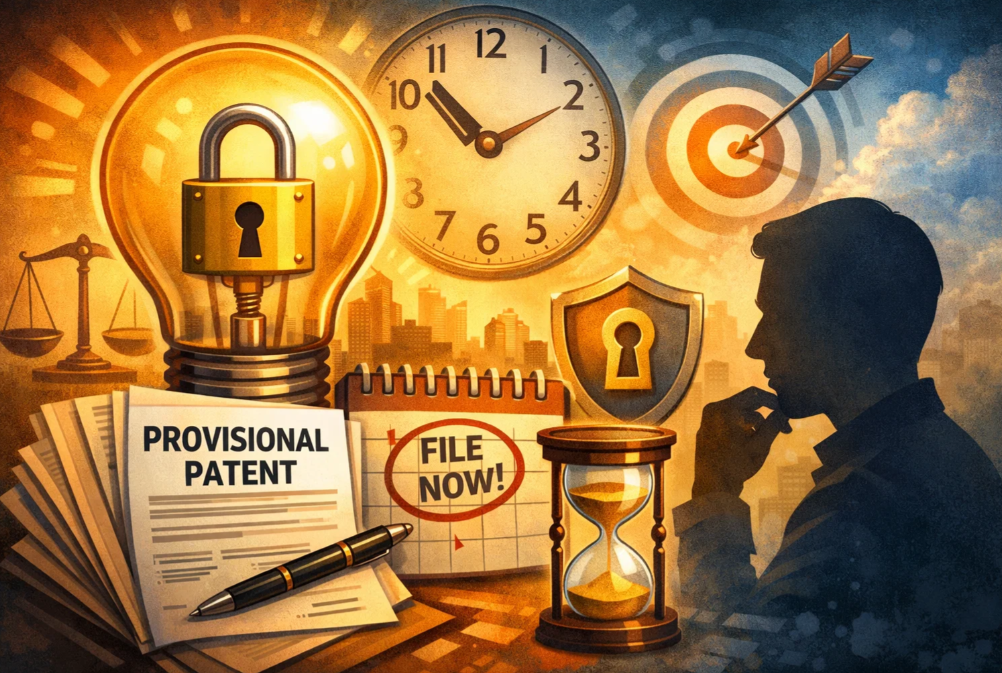
India follows a first-to-file system for patents, whoever files first usually wins. That means waiting to “perfect” your prototype can backfire if someone else files ahead of you.
Copyright and trademarks works differently, it’s linked to the date of creation and use respectively, not filing, but early registration still strengthens your legal position. (this may vary country to country)
Cost and Strategy
Patents → Highest cost, including drafting, filing, and maintenance.
Trademarks → Lower cost, modest renewals.
Copyrights → Cheapest, no renewals for most works.
Which to choose? That depends on what you’re building. If your tech is short-lived but your brand could last decades, a trademark may offer better ROI. But for unique, valuable inventions, a patent can be a game-changer.
Examples in Action
Clean-tech startup → Patent for the filtration method, trademark for the brand, copyright for the manual and demo video.
Film production → Copyright for the script, visuals, and music; trademark for the series title; patent for any unique filming equipment.
University research project → Patent for the innovation, copyright for the published paper, trademark for the institute’s branding.
Why Getting It Right Matters
These rights aren’t just legal shields, they’re business tools. They can attract investors, deter competitors, and boost valuation. Mismanaging them can mean losing control over your creation or worse, infringing someone else’s rights.
India’s IP system gives you all three tools, and global treaties like the PCT (patents), Madrid Protocol (trademarks), and Berne Convention (copyright) let you extend protection internationally.
The market won’t wait. Competitors won’t pause while you decide which right to file. You can’t stop competition, but you can stop them from using your invention, your brand, or your creative work.
That’s the difference between hoping for protection and actually having it.FAQs
1. I’ve created something new… how do I know whether I need a patent, copyright, or trademark?
Start by asking: what exactly are you trying to protect? If it’s how something works (a technical solution), you’re looking at a patent. If it’s creative content (writing, music, code, artwork), that’s copyright. If it’s your brand name or logo that identifies your business, that’s a trademark.
2. Can the same product be protected by more than one type of IP?
Yes, and often it should be. For example, a tech product could have a patent for its mechanism, copyright for its software and manuals, and a trademark for its brand name. These rights protect different aspects of the same product.
3. Do I automatically get copyright, or do I have to register it?
In India, copyright exists automatically from the moment you create the work. Registration is not mandatory, but it gives you stronger evidence if there’s a dispute or infringement case later.
4. If I register a trademark, does that protect my product idea too?
No. A trademark only protects your brand identity, the name, logo, slogan, or symbol that identifies your goods or services. It does not protect how your product works or how it is designed technically.
5. If I patent my invention, can someone copy my brand name?
Yes, unless you also protect your brand through a trademark. A patent protects the technical invention. It does not stop someone from using a confusingly similar brand name unless you have trademark protection.
6. How long does each type of protection last?
Patents last 20 years from the filing date (subject to annual renewals). Copyright generally lasts for the life of the author plus 60 years in India. Trademarks last 10 years per registration but can be renewed indefinitely as long as they are used and renewed on time.
7. Is software protected by patent or copyright in India?
Software code itself is protected under copyright as a literary work. However, if the software produces a technical effect or is integrated with hardware to solve a technical problem, it may also qualify for patent protection, provided it clears the “computer program per se” exclusion under patent law.
8. What happens if I don’t register anything? Am I still protected?
For copyright, you are protected automatically. For trademarks, you may get limited protection through prior use, but registration makes enforcement much easier. For patents, there is no protection unless you file and get the patent granted.
9. Which one is the most expensive to obtain and maintain?
Patents are generally the most expensive due to drafting complexity, examination, hearings, and annual renewal fees. Trademarks are comparatively affordable. Copyright registration is usually the least expensive of the three.
10. If someone copies my product design, should I file for trademark protection?
Not necessarily. If the issue is about the appearance or shape of a product, industrial design registration may be more appropriate. Trademarks protect brand identifiers, not functional product shapes.
11. Can I protect my idea before I actually launch my product?
Yes. For patents, India follows a first-to-file system, so filing early is critical. For trademarks, you can file based on “proposed to be used” even before launch. Copyright exists from creation, even before publication.
12. If I want protection outside India, do I need to file separately in every country?
Intellectual property rights are territorial. However, international systems make it easier. For patents, you can use the PCT route. For trademarks, the Madrid Protocol helps streamline multi-country filings. Copyright is automatically recognised across Berne Convention member countries, though enforcement procedures differ country to country.