As India continues to strengthen its position as a global hub for innovation, research, and entrepreneurship, the importance of intellectual property protection has become increasingly evident. Against this backdrop, the Women Institute of Technology (WIT), Dehradun, in association with the Uttarakhand State Council for Science & Technology (UCOST), organized a day-long National Webinar on Intellectual Property Rights (IPR). The programme brought together experts from academia, government, and the intellectual property profession to deliberate on the evolving landscape of patents, copyrights, trademarks, and innovation policy. UCOST has consistently supported IPR awareness initiatives across educational institutions in Uttarakhand to promote research commercialization and technology-led entrepreneurship.
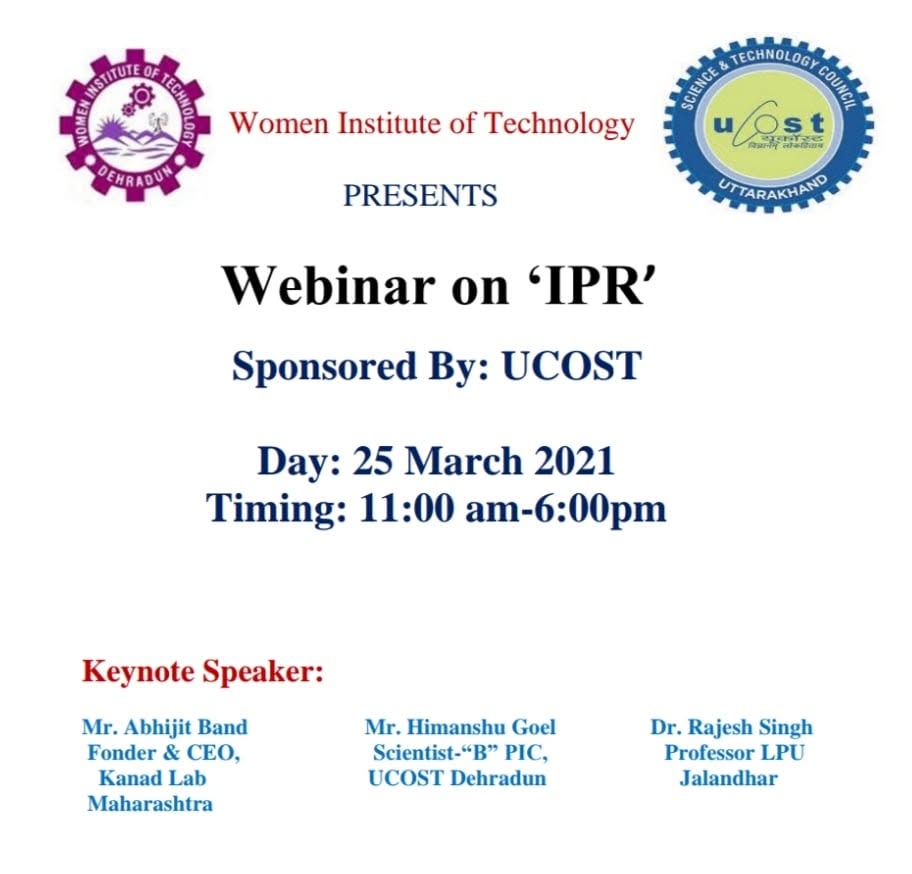
Among the keynote speakers was Mr. Abhijit Bhand, Founder & CEO of Kanadlab Institute of Intellectual Property & Research, who addressed students, researchers, innovators, and faculty members on the strategic importance of intellectual property in transforming ideas into valuable economic assets. Drawing upon his experience of working on more than 150 patent applications across diverse technologies and conducting hundreds of intellectual property awareness programmes, Mr. Bhand emphasized that innovation alone is not sufficient; it must be supported by a well-planned intellectual property strategy to generate commercial and societal value.
During his presentation, he explained the practical significance of patents, trademarks, copyrights, industrial designs, and geographical indications, while demonstrating how each form of intellectual property contributes differently to technological progress and business competitiveness. He encouraged young researchers to identify protectable innovations at the earliest stages of research rather than after publication, highlighting that premature public disclosure often results in the irreversible loss of patent rights.
A major focus of the session was India's patent policy framework and its unique attempt to balance innovation incentives with public interest. Mr. Bhand explained that unlike several jurisdictions that adopt an expansive approach to pharmaceutical patents, the Indian Patents Act, 1970, incorporates safeguards to prevent monopolies over incremental innovations lacking genuine therapeutic advancement. Particular attention was given to Section 3(d), one of the most debated provisions of Indian patent law, which restricts patents on new forms of known substances unless they demonstrate enhanced therapeutic efficacy.
To illustrate the practical application of this provision, Mr. Bhand discussed the landmark Novartis AG v. Union of India case, where the Supreme Court declined patent protection for the beta-crystalline form of the anti-cancer drug Imatinib Mesylate. The judgment has often been cited internationally as a defining example of India's commitment to preventing "evergreening" of pharmaceutical patents while ensuring affordable access to medicines. The discussion highlighted how the decision sparked global debate between multinational pharmaceutical companies advocating stronger patent protection and public health groups supporting broader access to life-saving medicines.
The webinar also explored one of the most significant contemporary controversies surrounding patents—the role of intellectual property during the COVID-19 pandemic. Referring to the international debate over vaccine patents, participants discussed India's proposal at the World Trade Organization seeking a temporary waiver of certain TRIPS obligations for COVID-19 technologies. The deliberations examined the complex policy question of whether patent protection should be relaxed during global health emergencies while simultaneously preserving incentives for pharmaceutical innovation. The session encouraged participants to appreciate that intellectual property law often requires balancing innovation, investment, and public welfare rather than choosing one objective over another.
Moving beyond pharmaceuticals, Mr. Bhand illustrated how patents have shaped innovation in engineering, electronics, artificial intelligence, renewable energy, and digital technologies. He emphasized that intellectual property has become a critical component of startup valuation, technology transfer, licensing, venture capital investment, and international competitiveness. Several examples were shared demonstrating how universities worldwide have successfully commercialized research through strategic patent management, thereby generating revenue while contributing to societal development.
The programme also addressed common misconceptions regarding patentability. Participants learned that patents do not protect abstract ideas but rather novel, inventive, and industrially applicable technical solutions. The discussion covered patent filing procedures, prior art searches, ownership issues arising from collaborative research, technology licensing, and the importance of maintaining confidentiality before filing applications. Students were encouraged to cultivate an innovation-first mindset supported by proper documentation and intellectual property planning.
An engaging question-and-answer session followed, during which participants raised queries relating to software patents, startup innovations, academic research, and commercialization of university-developed technologies. The interaction reflected the growing awareness among students and researchers that intellectual property is not merely a legal subject but an essential pillar of innovation management and economic development.
The webinar concluded with appreciation from the organizers for the valuable contributions made by all keynote speakers. Participants described the programme as highly informative, particularly for its balanced discussion of legal principles, policy debates, and real-world case studies. The event reaffirmed the importance of fostering intellectual property awareness within higher education institutions and strengthening India's innovation ecosystem through informed research, responsible technology development, and effective protection of intellectual assets.