While patents often dominate discussions on innovation, they represent only one part of the intellectual property ecosystem. Every successful business, whether a startup, creative enterprise, manufacturing company, or multinational corporation, relies on a combination of copyrights, trademarks, industrial designs, and patents to protect different aspects of its competitive advantage. Recognizing the growing need to build awareness beyond patents, Maratha Vidya Prasarak Samaj's K.R.T. Arts, B.H. Commerce and A.M. Science (KTHM) College, Nashik, organized an expert session on these critical forms of intellectual property as part of the MoE's Innovation Cell and AICTE Sponsored Impact Lecture Series 2021.
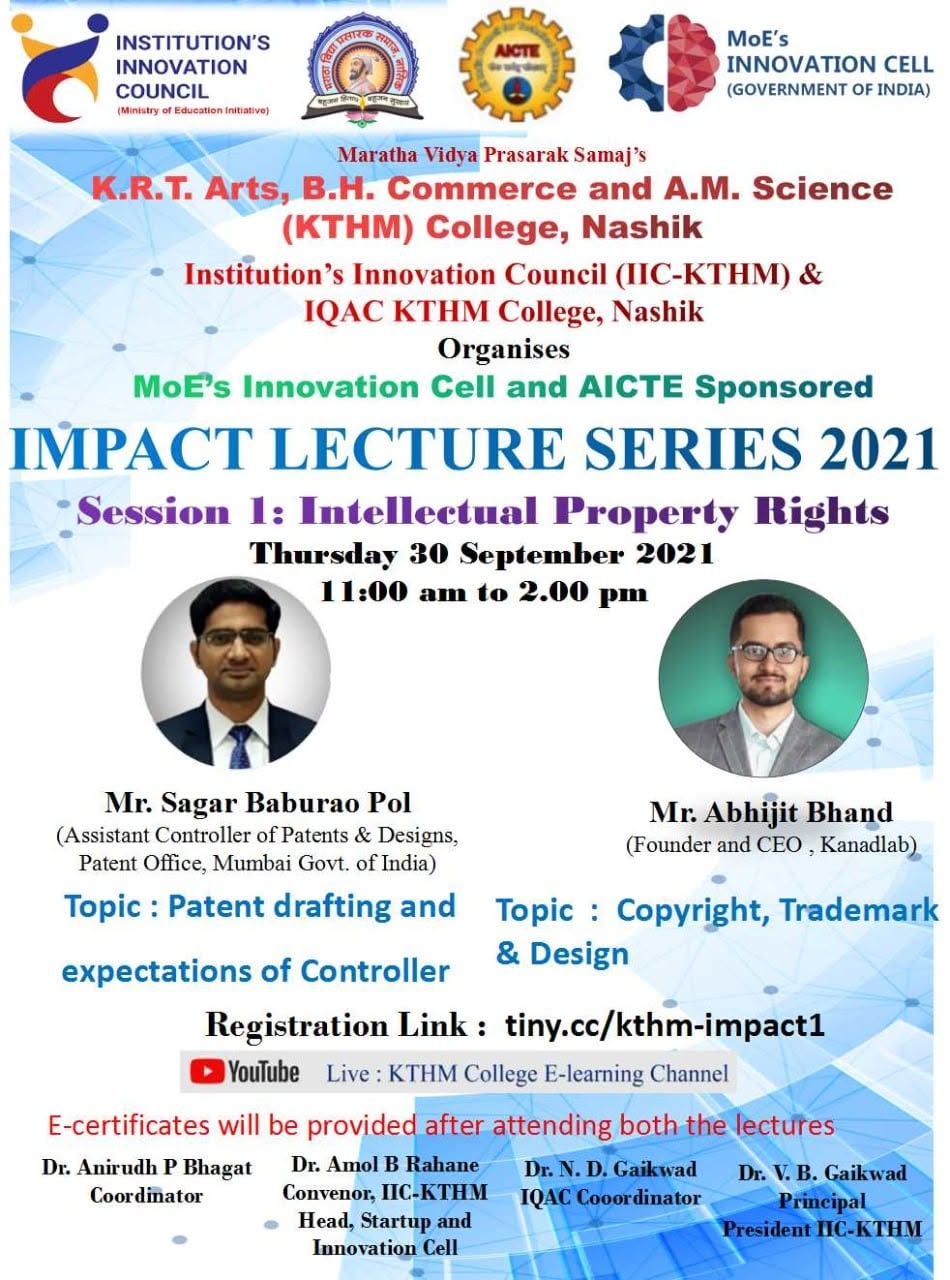
The programme was jointly organized by the Institution's Innovation Council (IIC-KTHM) and the Internal Quality Assurance Cell (IQAC), bringing together students, researchers, entrepreneurs, and faculty members to understand how intellectual property influences innovation, creativity, entrepreneurship, and business growth. The lecture series featured distinguished experts from both academia and government, including Mr. Sagar Baburao Pol, Assistant Controller of Patents & Designs, Patent Office, Government of India, who delivered an insightful session on patent drafting and the expectations of the Indian Patent Office during patent examination.
Complementing the technical discussion on patents, Mr. Abhijit Bhand, Intellectual Property Consultant and Registered Indian Patent Agent, delivered an expert session on Copyrights, Trademarks, and Industrial Designs, highlighting how these rights collectively shape the commercial success of modern enterprises. Rather than treating these rights as independent legal concepts, the session demonstrated how businesses strategically integrate multiple forms of intellectual property to create comprehensive protection around their products, brands, and creative assets.
Through practical examples from global and Indian industries, participants explored how Coca-Cola has protected one of the world's most valuable brands through trademark law for over a century, while maintaining its famous beverage formula as a closely guarded trade secret. The discussion also examined how companies such as LEGO combine trademarks, copyrights, design protection, and patents to safeguard different elements of their products and business model. From India, examples including Amul, Tata, and Asian Paints illustrated how strong brand identity, distinctive packaging, product aesthetics, and creative content contribute significantly to long-term business value and consumer trust.
A major focus of the session was the growing importance of industrial design protection, an often-overlooked form of intellectual property despite its enormous commercial significance. Participants learned how consumers frequently associate product quality with appearance and user experience, making design innovation a powerful competitive differentiator. Through examples from consumer electronics, automotive products, furniture, fashion, and household appliances, the session demonstrated how thoughtful product design not only enhances customer appeal but also creates valuable intellectual assets capable of generating sustained commercial advantage.
The discussion further highlighted the increasing role of copyrights within today's digital economy. As businesses continue expanding into software development, digital content creation, online education, entertainment, advertising, and social media, protecting original creative works has become more important than ever. Participants gained practical insights into ownership of creative content, licensing models, copyright infringement, and the commercialization of digital assets within an increasingly technology-driven marketplace.
The programme concluded with an engaging interaction where students raised questions on brand creation, copyright ownership, design registration, startup intellectual property strategy, and commercialization of creative works. The discussions reflected the growing recognition that intellectual property extends far beyond inventions and plays an equally significant role in shaping successful businesses across every sector of the economy.
The successful organization of the programme was made possible through the dedicated efforts of the Institution's Innovation Council (IIC-KTHM) and IQAC KTHM College under the guidance of Dr. V. B. Gaikwad, Principal and President, IIC-KTHM, together with Dr. Amol B. Rahane, Convener of IIC-KTHM and Head of the Startup & Innovation Cell, Dr. Anirudh P. Bhagat, Coordinator, and Dr. N. D. Gaikwad, IQAC Coordinator. Their initiative in bringing together experts from the Indian Patent Office and industry created an excellent platform for strengthening intellectual property awareness among aspiring innovators and entrepreneurs.
By introducing participants to the broader landscape of copyrights, trademarks, industrial designs, and patents, the Impact Lecture Series reinforced an important message: successful innovation is not protected by a single intellectual property right, but by a carefully designed strategy that safeguards every valuable aspect of an idea—from technology and design to creativity and brand identity.