India's agricultural sector is undergoing a remarkable transformation. Once driven primarily by traditional farming practices, it is now witnessing rapid innovation through precision agriculture, biotechnology, climate-smart farming, automation, digital advisory platforms, seed technologies, post-harvest solutions, and agri-fintech. As this transformation accelerates, intellectual property has emerged as one of the most valuable strategic assets for agritech startups and agricultural enterprises seeking to commercialize innovation and compete in national as well as global markets.
With this objective, Mr. Abhijit Bhand, Intellectual Property Consultant and Registered Indian Patent Agent, was invited to deliver an expert session on "IPR Strategies for Startups and MSMEs" at the Incubation Centre of ICAR – Directorate of Onion and Garlic Research (ICAR-DOGR), Pune. The programme brought together approximately 130 participants, including agritech startups, entrepreneurs, MSME representatives, researchers, scientists, and innovators working across various domains of agricultural technology.
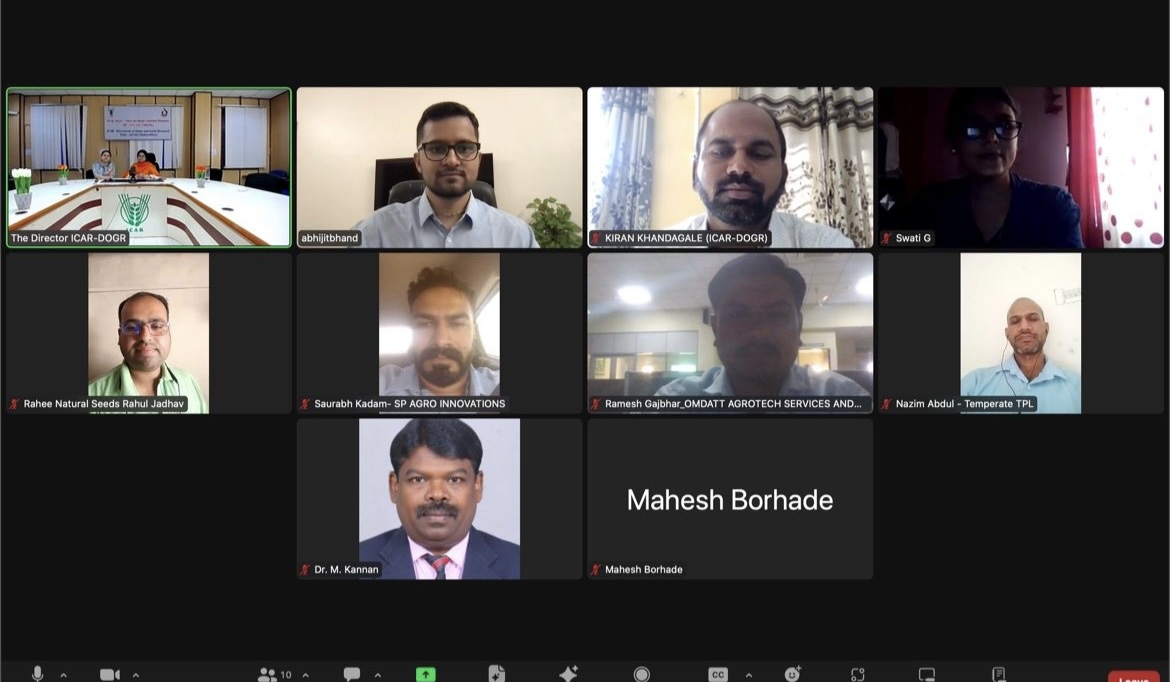
The session commenced with a welcome address by Dr. Rajiv Kale, Senior Scientist, ICAR-DOGR, who highlighted the growing significance of innovation-led entrepreneurship in Indian agriculture and emphasized the importance of strengthening collaboration between scientific research institutions and emerging agribusinesses. He encouraged participants to leverage intellectual property as an important instrument for translating research outcomes into commercially impactful technologies capable of benefiting farmers and society.
During the technical session, Mr. Bhand discussed how intellectual property has become an essential component of modern agribusiness strategy. Agriculture today extends far beyond crop cultivation—it encompasses biotechnology, farm mechanization, precision irrigation, biological inputs, food processing, digital agriculture, artificial intelligence, and supply chain innovations. Each of these domains relies heavily on research, technological advancement, and proprietary know-how, making effective intellectual property management indispensable for sustainable business growth.
Adding a valuable industry perspective to the programme, Mr. Saurabh Kadam, Director of SP Agro Innovations LLP, shared the startup's journey of developing and commercializing its innovative agricultural technology. Drawing from firsthand experience, he highlighted the importance of intellectual property in safeguarding innovation and acknowledged the professional guidance provided by Mr. Abhijit Bhand in securing intellectual property protection for India's first indigenously developed seedling transplanter. He explained how strategic IP protection enabled the company to establish a strong market position, with the technology now being commercialized across India, exported to multiple countries, and recognized through several prestigious national and international awards, grants, and funding support exceeding ₹1 crore.
Rather than approaching intellectual property purely from a legal perspective, the session examined its commercial significance throughout the innovation lifecycle. Participants explored how patents, trademarks, copyrights, trade secrets, industrial designs, and contractual mechanisms can collectively strengthen business competitiveness, facilitate technology transfer, attract investors, and create licensing opportunities. The discussion emphasized that intellectual property should be integrated into business strategy from the earliest stages of product development rather than being considered only after commercialization.
Several real-world examples illustrated how innovation has reshaped global agriculture. Participants discussed how companies such as John Deere transformed conventional agricultural machinery into intelligent precision farming platforms through patented automation, GPS guidance, sensors, and data-driven technologies. Similarly, Netafim revolutionized water-efficient agriculture through innovations in drip irrigation systems that are now deployed across numerous countries facing water scarcity. From India, examples of companies such as Mahyco, Nuziveedu Seeds, and emerging agritech startups demonstrated how sustained investment in research, plant breeding, biotechnology, and proprietary technologies has enabled businesses to create long-term value while addressing critical agricultural challenges.
The discussion also focused on one of the most overlooked aspects of agritech entrepreneurship, the commercialization of research. Developing an innovative agricultural product often requires years of experimentation, field validation, regulatory compliance, and substantial financial investment. Without appropriate intellectual property protection, startups may find it difficult to recover development costs or attract strategic partners. Participants therefore examined how intellectual property serves as a bridge between laboratory innovation and successful market adoption by enabling licensing, collaborative research, technology transfer, franchising, and strategic partnerships.
Recognizing the increasing participation of startups in India's agricultural ecosystem, the session also addressed practical challenges encountered by early-stage ventures. Topics such as ownership of innovations developed through collaborative research, maintaining confidentiality before public disclosure, freedom-to-operate considerations, branding agricultural products, and developing comprehensive intellectual property portfolios were discussed through practical examples and interactive case studies. The objective was to provide entrepreneurs with actionable strategies that could be implemented immediately within their businesses.
The programme concluded with an engaging question-and-answer session, during which participants discussed a broad range of issues including patentability of agricultural inventions, protection of biological innovations, licensing strategies, enforcement of intellectual property rights, startup funding, and commercialization of publicly funded research. The interactive discussions reflected the participants' strong interest in integrating intellectual property into their long-term business strategies and highlighted the increasing maturity of India's agritech innovation ecosystem.
The programme was successfully organized by the Incubation Centre of ICAR–DOGR, bringing together researchers, startups, MSMEs, and innovators on a common platform to explore the commercial dimensions of agricultural innovation. Such initiatives play a significant role in strengthening India's innovation ecosystem by connecting scientific research with entrepreneurship and promoting the effective commercialization of technologies developed for the agricultural sector.
As India continues its journey towards technology-driven and sustainable agriculture, intellectual property will remain a critical enabler of innovation, investment, and economic growth. Through expert engagements with research institutions, incubation centres, universities, startups, and industry bodies, Abhijit Bhand continues to contribute towards building a stronger innovation ecosystem where agricultural research is effectively protected, strategically commercialized, and translated into meaningful value for farmers, businesses, and society.