The success of a startup is rarely determined by innovation alone. The ability to protect, manage, and commercialize that innovation often becomes the defining factor between a promising idea and a sustainable business. Recognizing the growing importance of intellectual property in India's expanding startup ecosystem, Amrutvahini College of Pharmacy organized an expert webinar on "IP, Innovation & Startups" under the aegis of the Institution's Innovation Council (IIC), Ministry of Education, Government of India.
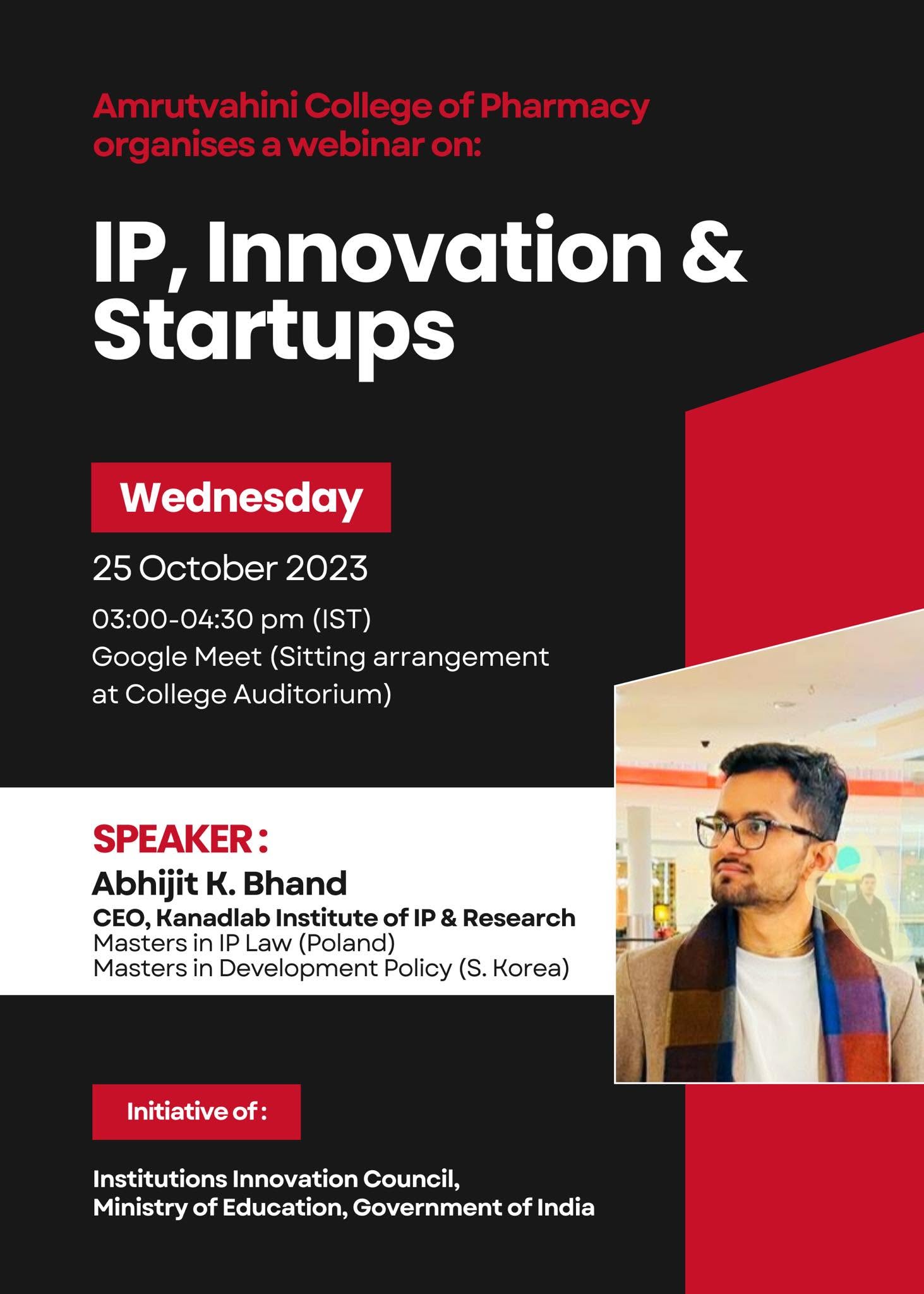
The session featured Mr. Abhijit Bhand, Intellectual Property Consultant and Registered Indian Patent Agent, who interacted with pharmacy students, researchers, aspiring entrepreneurs, and faculty members on the strategic role of intellectual property in building innovation-driven enterprises. While intellectual property is often viewed as a legal formality, the discussion highlighted its far broader significance as a business tool capable of attracting investment, strengthening market position, enabling collaborations, and creating long-term enterprise value.
The webinar focused on the complete innovation journey—from identifying a problem and developing a novel solution to protecting and commercializing the resulting intellectual assets. Participants were encouraged to understand that innovation should not conclude with product development; rather, it should continue through effective intellectual property management, branding, licensing, and technology commercialization.
Using practical examples from the healthcare and pharmaceutical sectors, Mr. Bhand explained how many globally successful companies derive their competitive advantage not merely from manufacturing capabilities but from proprietary knowledge and intellectual assets. Companies such as Pfizer, Roche, and AbbVie have built global leadership through continuous investment in research, robust patent portfolios, and strategic technology licensing, while Indian pharmaceutical companies including Sun Pharmaceutical Industries, Dr. Reddy's Laboratories, and Cipla have demonstrated how research-driven innovation combined with effective intellectual property strategies can successfully compete in international markets. These examples enabled participants to appreciate that intellectual property serves not only as legal protection but also as an important driver of business growth and global competitiveness.
A significant part of the discussion also explored the realities faced by early-stage startups. Participants learned how intellectual property often influences investor confidence, technology valuation, strategic partnerships, and market expansion. Through practical case studies, the session demonstrated that a well-structured intellectual property portfolio can substantially enhance a startup's credibility while reducing business risks associated with imitation and market competition.
Recognizing the entrepreneurial potential within pharmacy education, the programme encouraged students to think beyond conventional career paths and explore opportunities in healthcare innovation, medical technologies, nutraceuticals, biotechnology, digital health, and pharmaceutical product development. Participants were introduced to the importance of integrating intellectual property planning into research projects from the earliest stages, enabling scientific discoveries to evolve into commercially successful products capable of addressing real-world healthcare challenges.
The webinar concluded with an interactive discussion where students raised questions relating to patentability of pharmaceutical inventions, startup formation, technology licensing, ownership of innovations developed within academic institutions, and commercialization pathways for research-based products. The enthusiastic participation reflected the growing interest among young researchers in translating scientific innovation into entrepreneurial ventures.
The programme was successfully organized by Amrutvahini College of Pharmacy under the Institution's Innovation Council (IIC), Ministry of Education, reaffirming the institution's commitment to promoting innovation, entrepreneurship, and intellectual property awareness among future healthcare professionals. By creating a platform where innovation intersects with business strategy and intellectual property, the initiative equipped participants with practical insights into the knowledge-driven economy.
As India's pharmaceutical and biotechnology sectors continue to expand globally, understanding intellectual property has become an essential competency for researchers and entrepreneurs alike. Through expert engagements with universities, incubation centres, research institutions, and startup ecosystems, Mr. Abhijit Bhand continues to contribute towards strengthening innovation capacity and promoting the effective commercialization of research through strategic intellectual property management.