Every line of code, every algorithm, every hardware design, and every software application begins as an idea. However, in today's digital economy, the true value of an idea lies not only in its technical excellence but also in the ability to protect and commercialize it. With this objective, the Department of Computer Engineering, Amrutvahini College of Engineering, Sangamner, invited Mr. Abhijit Bhand, Intellectual Property Consultant and Registered Indian Patent Agent, to deliver an expert lecture on "Intellectual Property Rights."
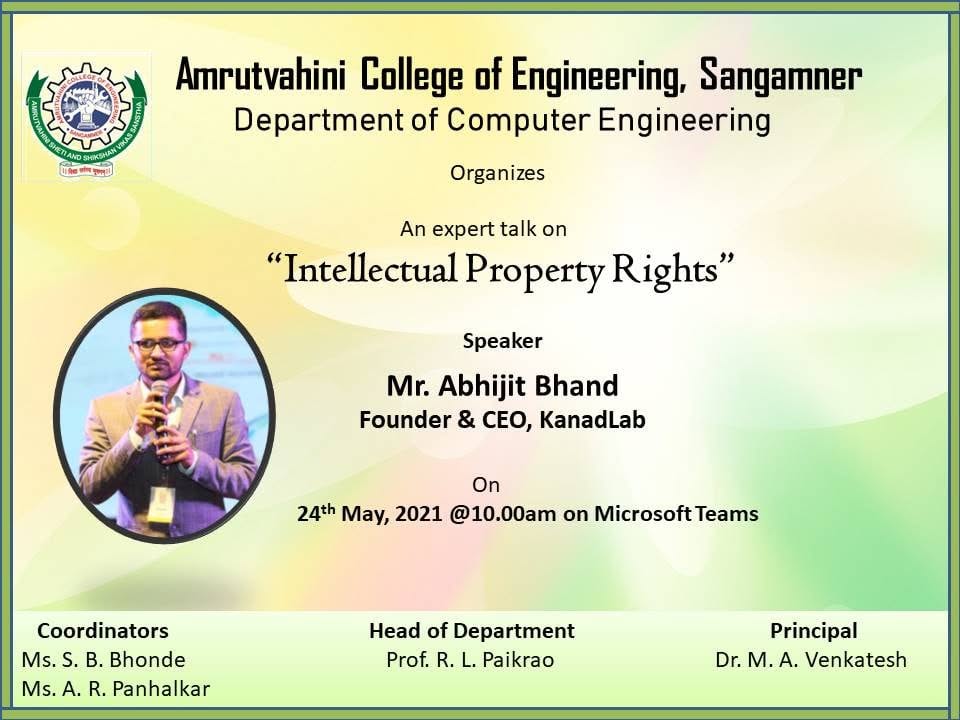
Conducted virtually through Microsoft Teams, the session introduced engineering students to the growing relevance of intellectual property in the technology sector, where innovation has become the primary driver of economic growth. The discussion encouraged participants to look beyond software development and product engineering and understand how intellectual property influences the success of technology companies across the world.
Instead of beginning with legal definitions, the session started with a practical question: Why do some technology companies remain market leaders despite rapid technological change? The answer, participants discovered, lies in the strategic management of intellectual property. Through engaging examples, the lecture explained how companies combine patents, copyrights, trademarks, industrial designs, and trade secrets to build sustainable competitive advantages.
Drawing examples from the digital economy, participants explored how Google has built one of the world's strongest technology ecosystems through continuous innovation, proprietary technologies, and an extensive patent portfolio. The discussion also highlighted how Adobe transformed the software industry by protecting its creative technologies while building globally recognized digital products, and how GitHub, Atlassian, and other technology-driven enterprises rely on a combination of software copyrights, trademarks, licensing models, and proprietary know-how to create scalable businesses serving millions of users worldwide.
A key highlight of the lecture was the growing relationship between computer engineering and intellectual property. Students learned that innovations in artificial intelligence, cybersecurity, cloud computing, blockchain, data analytics, mobile applications, embedded systems, and the Internet of Things frequently involve multiple forms of intellectual property protection. Rather than viewing engineering solely as product development, participants were encouraged to recognize intellectual property as a strategic component of innovation management and technology entrepreneurship.
The session also addressed the entrepreneurial opportunities available to engineering students. India has rapidly emerged as one of the world's leading startup ecosystems, with technology startups solving challenges across education, healthcare, finance, manufacturing, logistics, and agriculture. Participants discussed how protecting intellectual property from the early stages of product development enhances investor confidence, facilitates technology commercialization, and strengthens long-term business competitiveness.
The programme concluded with an interactive discussion where students sought guidance on software patents, ownership of student innovations, startup formation, open-source technologies, and career opportunities in intellectual property. The enthusiasm and curiosity displayed by the participants reflected the growing awareness that future engineers must combine technical expertise with an understanding of innovation management and intellectual property strategy.
The expert talk was successfully organized by the Department of Computer Engineering, Amrutvahini College of Engineering, under the guidance of Dr. M. A. Venkatesh, Principal, Prof. R. L. Paikrao, Head of the Department, and the coordinators Ms. S. B. Bhonde and Ms. A. R. Panhalkar, whose efforts created a valuable learning opportunity for aspiring engineers.
By encouraging students to view intellectual property as an essential extension of engineering innovation, the session reinforced a simple yet powerful message: the technologies that shape the future are not only invented—they are strategically protected, responsibly commercialized, and continuously improved.