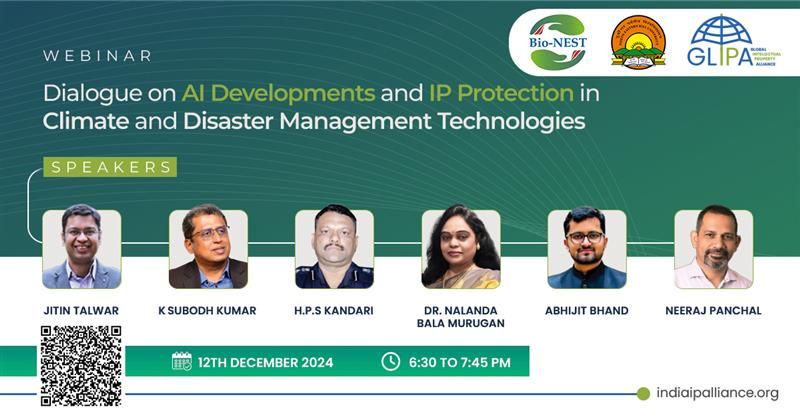
On 12 December 2024, the Global Intellectual Property Alliance (GLIPA-India) organised an important and timely conversation titled the “Dialogue on AI Developments and IP Protection in Climate and Disaster Management Technologies.” The programme examined how artificial intelligence can strengthen disaster preparedness and climate resilience in Northeast India, while also addressing the intellectual property structures required to responsibly protect and scale such technologies.
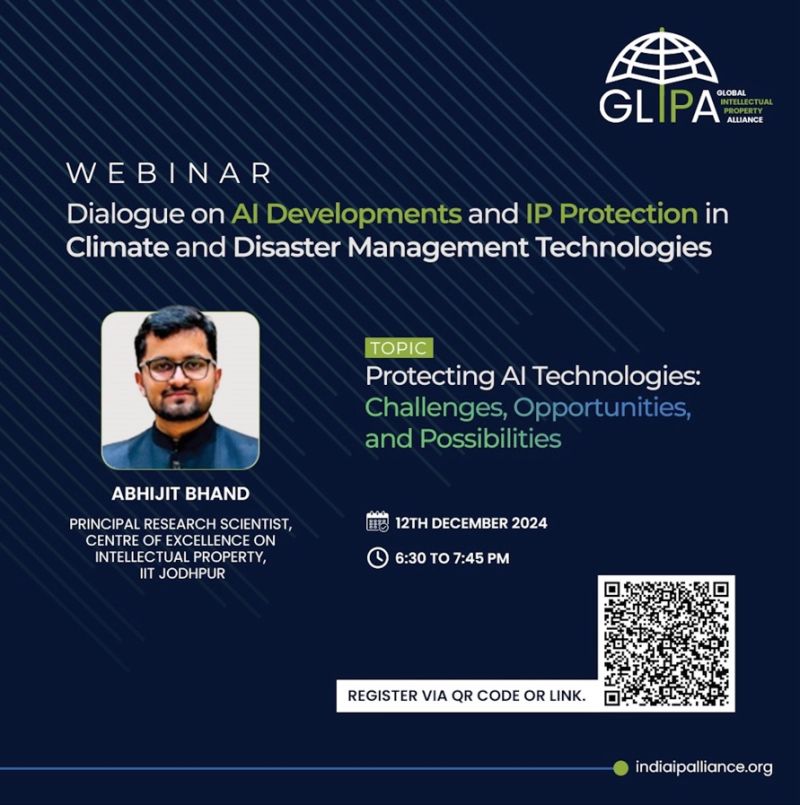
The discussion brought together voices from enforcement, industry, academia, and the IP ecosystem. Among them was Abhijit Bhand, who spoke on “Protecting AI Technologies: Challenges, Opportunities, and Possibilities”. His address focused on how existing IP frameworks must evolve to meaningfully accommodate AI-driven innovation in public-interest domains such as climate and disaster management.
The Session and Its Contributors
The programme began with introductory remarks by:
Mr. Jitin Talwar - Founder, TT Consultants | XLSCOUT | Talwar Advocates
Introductory Remarks on GLIPA IPA Initiatives
The session was chaired by:
Mr. Subodh Kumar - Head - IP Services, Tata Consultancy Services
Session Chair
Mr. Kumar played a pivotal role in steering the dialogue beyond theoretical discussion. He framed the session around a practical question: how can AI innovation be structured, protected, and deployed in ways that are both commercially viable and socially responsible? His moderation ensured that the technical, operational, and legal dimensions of AI were interlinked rather than treated in silos.
The panel of speakers included:
Mr. H. P. S. Kandari - Commandant, 1st Battalion NDRF, Guwahati
Artificial Intelligence: An Enabling Tool Towards Disaster ResilienceDr. Nalanda Bala Murugan - Co-founder & MD, NAM IP Boardroom; Principal Consultant, BioNest
Managing AI Technologies: IP Modalities and Policy Approaches for ImprovementMr. Abhijit Bhand - Co-founder, Kanadlab Institute of Intellectual Property & Research
Protecting AI Technologies: Challenges, Opportunities, and PossibilitiesMr. Neeraj Panchal - Senior Intellectual Property Counsel, John Deere
Connecting the Dots - Potential Challenges of AI
Each speaker approached the theme from a distinct perspective, operational readiness, regulatory design, corporate implementation, and legal structuring, creating a well-rounded and cohesive exchange.
AI in Disaster Management: Beyond Theory
The Northeast region of India faces recurring floods, landslides, seismic vulnerability, and increasing climate variability. AI systems are now being deployed to process satellite imagery, model rainfall intensity, predict flood zones, optimize evacuation strategies, and assist real-time disaster response teams.
Mr. Kandari’s remarks brought necessary realism into the discussion. From an operational standpoint, AI is not an abstract concept—it is a decision-support tool that can determine the speed and precision of rescue efforts. Predictive intelligence, when deployed effectively, can save lives.
Yet technological deployment at this scale also raises structural questions: who owns the technology, who controls the data, and how is innovation incentivized?
It was at this intersection that Mr. Bhand’s presentation assumed significance.
Protecting AI Technologies: A Structured Approach
In his address, Mr. Bhand began by clarifying a foundational point: intellectual property law does not protect “AI” as a concept. It protects specific technical implementations, inventive architectures, creative expressions, and commercially distinctive identities built around AI systems.
He explained that AI-driven disaster management technologies are rarely single-layered inventions. They typically involve:
Algorithmic models and system architecture
Software code and interfaces
Curated training datasets
Hardware integrations with sensors or monitoring systems
Deployment platforms and branding structures
Each of these components may require a different form of protection: patents, copyright, trade secrets, or trademarks. The real challenge, he noted, lies in strategically identifying what to protect and how.
Rather than advocating aggressive monopolisation, he emphasised calibrated protection. In public-interest technologies, IP must enable collaboration, not obstruct it.
Patentability and Technical Contribution
A substantial portion of his talk addressed patent eligibility. In India, computer-related inventions and mathematical methods face statutory exclusions unless they demonstrate a clear technical effect or technical contribution.
AI-based disaster prediction systems often rely heavily on data processing and statistical modeling. If described merely as algorithms, they risk being rejected. However, if drafted to highlight:
Integration with environmental sensors
System-level architecture
Measurable improvements in predictive accuracy
Real-world technical implementation
they stand on firmer legal ground.
Mr. Bhand underscored that drafting strategy becomes decisive in AI filings. The manner in which the invention is framed, technical problem, technical solution, and technical effect, can determine its fate.
His intervention reflected both doctrinal clarity and practical filing experience, offering insights particularly relevant for innovators and institutions working on AI-enabled climate technologies.
Data, Ownership, and Ethical Balance
Another critical issue addressed was data governance. AI systems in climate management rely on vast meteorological and geospatial datasets, often generated or controlled by public institutions.
While raw data may not always qualify for IP protection, curated datasets, structured compilations, and proprietary training methodologies may be safeguarded through trade secret mechanisms or contractual arrangements.
However, in disaster management contexts, exclusive control over critical data can raise ethical concerns. Mr. Bhand highlighted the importance of balanced licensing structures and public-private collaborations. Innovation must be incentivised, but accessibility in life-saving applications cannot be compromised.
This nuanced position, protect, but do not overprotect, resonated strongly within the discussion.
AI-Generated Innovations and Legal Uncertainty
The session also explored the evolving issue of AI-generated outputs. As AI systems become increasingly autonomous, improvements to predictive models may be machine-generated with minimal direct human intervention.
Under current Indian law, inventorship requires human agency. AI cannot be recognised as an inventor. Mr. Bhand clarified that ownership must be anchored in human contribution, designing, training, configuring, and supervising the system.
He advised innovators to maintain clear documentation of human involvement in AI development cycles. In emerging technologies, record-keeping may prove as important as technical advancement itself.
India’s Regulatory Path Forward
In comparing global approaches, the European Union has opted for a structured AI regulatory framework, while the United States continues to evolve largely through judicial interpretation.
Mr. Bhand suggested that India’s approach is likely to be pragmatic and adaptive. Rather than immediate sweeping legislation, gradual clarification through guidelines, examination practices, and policy notes may shape the trajectory.
For disaster and climate technologies, regulatory certainty will play a vital role in attracting research investment and scaling innovation.
A Thoughtful and Grounded Contribution
What stood out in Mr. Bhand’s address was not rhetorical flourish, but structured reasoning. He positioned intellectual property not as a technical afterthought, but as a foundational pillar in AI-driven ecosystems.
In climate and disaster management, technology must move quickly. But speed without legal clarity creates vulnerability, both for innovators and for institutions deploying the technology.
His core message was measured yet firm: IP strategy in AI must be intentional, technically sound, and ethically aligned with the public interest.
To sum up...
The Dialogue on AI Developments and IP Protection in Climate and Disaster Management Technologies demonstrated that conversations around AI cannot remain confined to code and computation. They must extend into governance, law, and responsible innovation.
Through insights from enforcement authorities, corporate IP leaders, policy experts, and research professionals, the session built a coherent narrative: AI can significantly enhance disaster resilience - but only if supported by well-structured legal frameworks.
In articulating the challenges, opportunities, and future possibilities of protecting AI technologies, Mr. Bhand contributed a perspective grounded in legal depth and practical understanding. As climate risks intensify and AI capabilities expand, such structured engagement between technology and law will become increasingly indispensable.
The December 12 dialogue was not merely an academic exchange. It was a reflection of the evolving responsibility carried by intellectual property professionals in shaping the future of technological resilience.