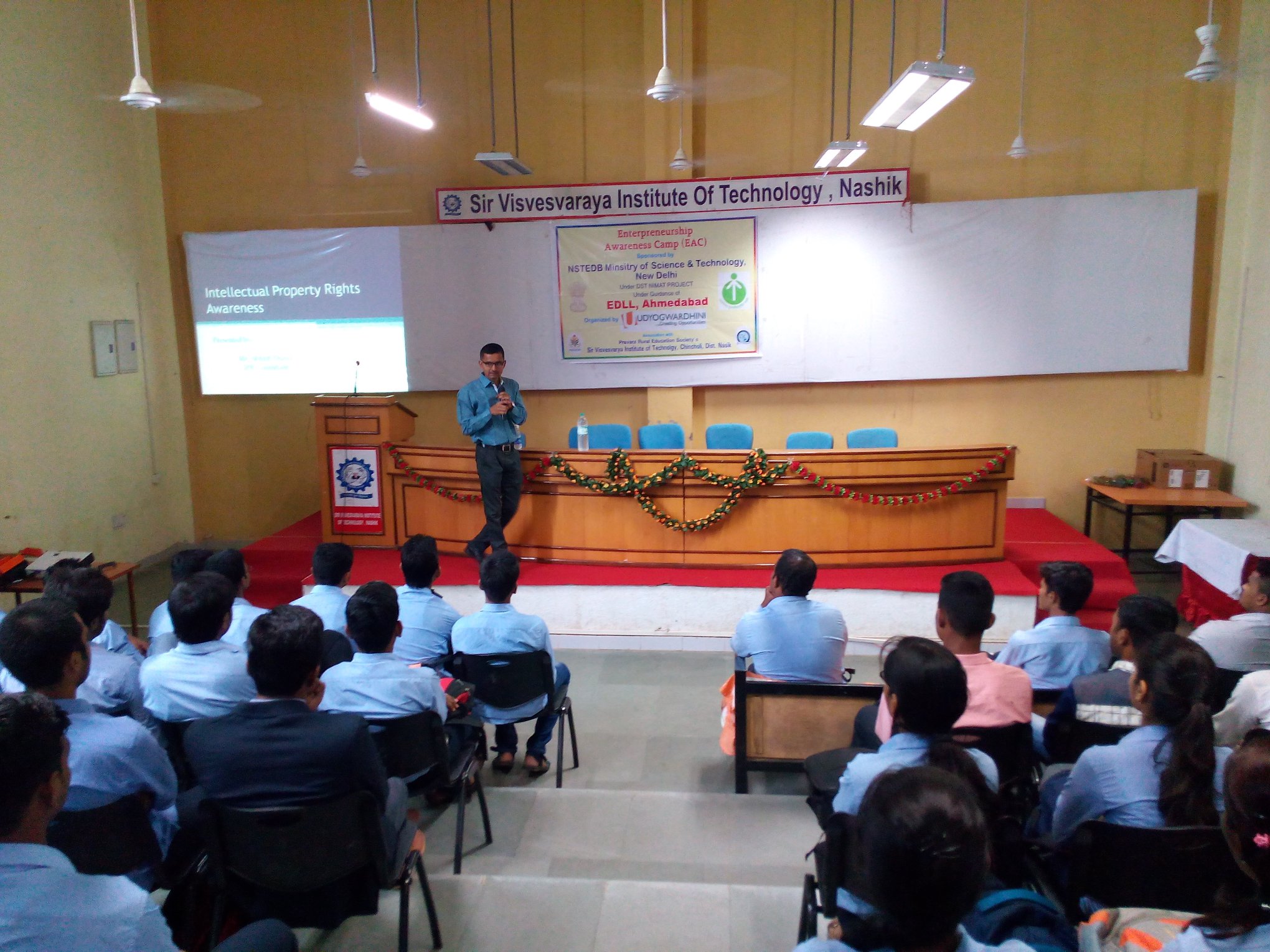
In January 2018, an Entrepreneurship Awareness Camp was organised by Udyogvardhini and sponsored by NSTEDB, Ministry of Science and Technology, New Delhi, at Sir Vishweshwaraiah Institute of Technology, Chincholi, District Nashik. The programme was designed to sensitise engineering students to the realities of building enterprises in a competitive and innovation-driven economy.
Among the invited speakers was Abhijit Bhand, who addressed more than 600 students from the engineering faculty on the theme of Intellectual Property for Entrepreneurship. His session focused on a subject that is often overlooked in early-stage innovation conversations but remains central to sustainable business growth.
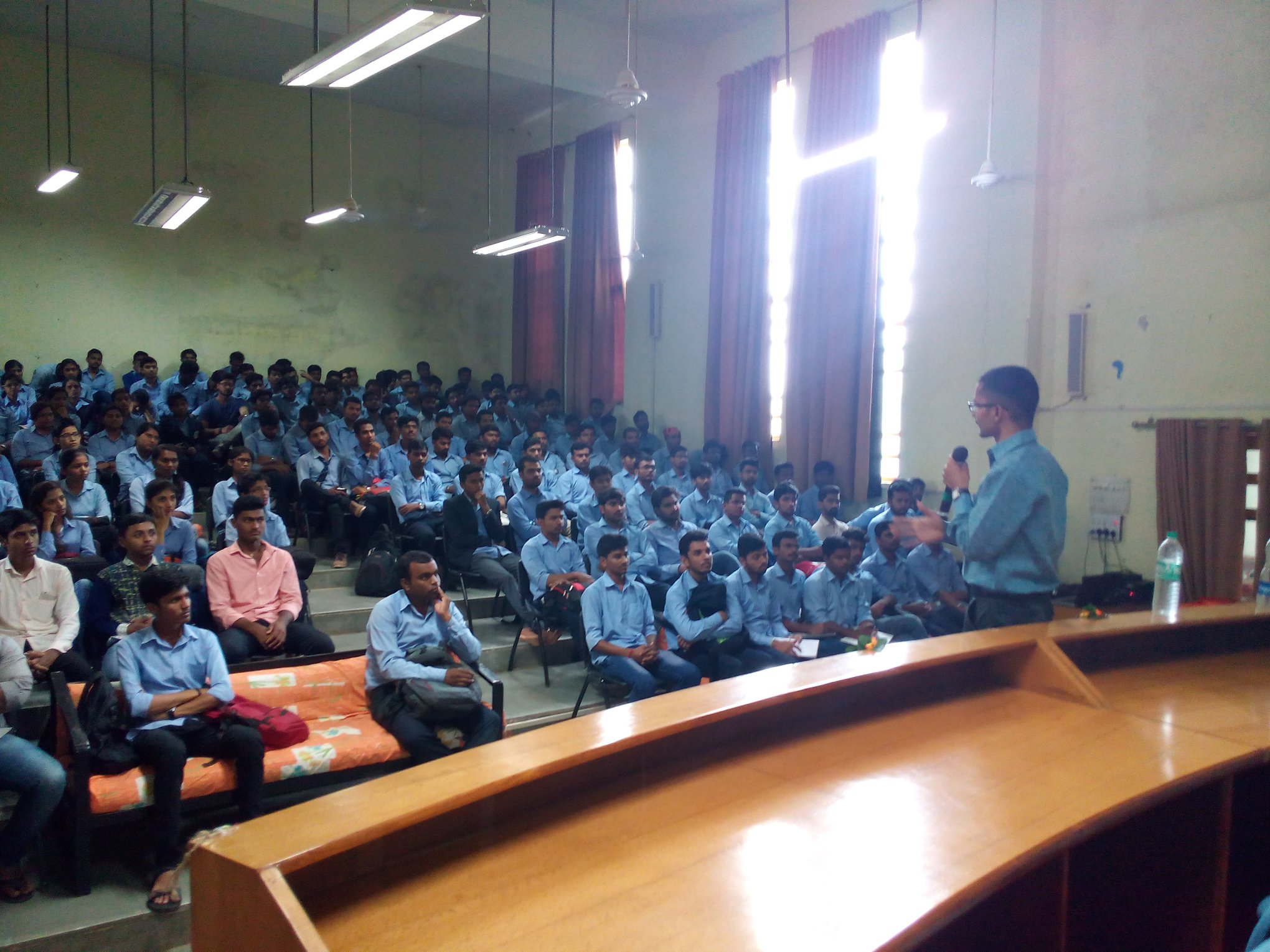
The scale of participation itself reflected the seriousness of the initiative. The auditorium was filled with students representing different engineering disciplines, many of whom were exploring startup ideas, technical projects, or industry collaborations. The atmosphere was attentive and engaged, indicative of a generation increasingly interested in creating ventures rather than merely seeking employment.
Framing Intellectual Property as a Business Tool
Mr. Bhand’s address did not approach intellectual property as a purely legal doctrine. Instead, it was positioned as a strategic instrument for entrepreneurs. The session began with a simple but fundamental premise. Every innovation carries value, but that value can only be sustained if it is protected.
For young engineers developing prototypes, software tools, mechanical designs, or process improvements, the question is not whether innovation exists. The question is whether it is defensible.
He explained that intellectual property operates at the structural level of a business. Patents protect technological inventions. Trademarks secure brand identity. Copyright safeguards software and creative works. Trade secrets preserve confidential know-how. When aligned properly, these rights form the backbone of a startup’s competitive position.
The emphasis was not on memorising legal provisions. It was on understanding strategic application.
Early Protection and the Risk of Disclosure
One of the most practical discussions during the session revolved around timing. Student innovators frequently assume that legal protection should follow once a product is perfected or ready for market. Mr. Bhand clarified that under Indian patent law, novelty is determined by disclosure. Public presentation, publication, or even informal circulation of technical details can compromise patentability.
For engineering students participating in competitions, exhibitions, or research conferences, this insight proved particularly relevant. Securing a priority date before public disclosure can be decisive.
The message delivered was clear and measured. Perfection can be iterative. Protection must be timely.
Intellectual Property and Investment Readiness
Another dimension explored during the session was the relationship between intellectual property and funding. Investors assess not only the novelty of an idea but also the defensibility of the business model. A startup that owns protectable technology or a registrable brand demonstrates seriousness, planning, and long-term intent.
Intellectual property creates intangible assets that strengthen enterprise valuation. For technology-driven ventures, these assets often represent a significant portion of the company’s worth.
In the context of Nashik and its surrounding industrial region, where manufacturing and technology enterprises are steadily emerging, this understanding carries practical importance. Engineering graduates equipped with IP awareness are better positioned to build ventures that attract capital and partnerships.
Avoiding Common Entrepreneurial Errors
The session also addressed common mistakes frequently observed in early-stage ventures. These included selecting descriptive brand names that are difficult to register, neglecting prior art searches, assuming that informal confidentiality agreements are sufficient protection, and delaying filings until after public exposure.
Such errors are rarely intentional. They arise from lack of structured guidance. By introducing these considerations at the academic stage, the programme sought to reduce avoidable risks for future entrepreneurs.
Mr. Bhand’s approach was analytical yet accessible. Complex legal concepts were explained through practical examples drawn from real-world startup scenarios, making the discussion relatable to the engineering audience.
Impact on the Regional Startup Ecosystem
The Entrepreneurship Awareness Camp of January 2018 was not an isolated academic event. It formed part of a broader effort to strengthen the startup and business ecosystem of Nashik and the surrounding region.
Engineering institutions serve as incubators of ideas. When students are exposed to intellectual property strategy at this formative stage, innovation pipelines become more structured. Projects are conceived with protection in mind. Branding decisions are made with registrability considerations. Technical research is documented with clarity.
The participation of over 600 students indicated the scale at which such awareness can influence future ventures. Even if a fraction of those attendees pursue entrepreneurial paths, the ripple effect extends beyond individual careers to regional economic development.
Nashik has historically been known for its industrial activity. With growing interest in technology-based enterprises, structured IP education strengthens the foundation for sustained growth.
Institutional Collaboration and Vision
The collaboration between Udyogvardhini and NSTEDB, Ministry of Science and Technology, reflects a policy-level recognition that entrepreneurship requires more than financial support. It requires knowledge infrastructure.
By integrating intellectual property awareness into entrepreneurship programmes, institutions send a clear signal. Innovation must be accompanied by protection. Creativity must be aligned with compliance. Ambition must be supported by structure.
The seminar at Sir Vishweshwaraiah Institute of Technology illustrated how academic platforms can bridge the gap between theoretical learning and commercial reality.
Intellectual Property as Entrepreneurial Discipline
A recurring theme throughout the session was discipline. Entrepreneurship is often associated with agility and rapid experimentation. However, sustainable ventures are built on methodical foundations.
An entrepreneur who evaluates novelty before disclosure, selects distinctive branding from the outset, and structures protection strategies early operates with strategic advantage. Intellectual property is not an afterthought. It is an integral part of business planning.
The discussion encouraged students to treat their ideas as assets. Assets must be secured, documented, and managed.
Concluding Reflections
The January 2018 Entrepreneurship Awareness Camp stands as a meaningful engagement between legal strategy and engineering innovation. Addressing more than 600 students from the engineering faculty, Mr. Bhand’s session contributed to shaping how young innovators perceive intellectual property.
Rather than viewing IP as a complex legal hurdle, the participants were encouraged to see it as a growth enabler. Such awareness, introduced at the academic stage, strengthens the startup culture of Nashik and the surrounding region.
Innovation thrives where ideas are protected.
Entrepreneurship accelerates where protection is understood.
The impact of that session continues to resonate in the evolving startup landscape of the region, reflecting the importance of embedding intellectual property literacy into the foundations of enterprise creation.