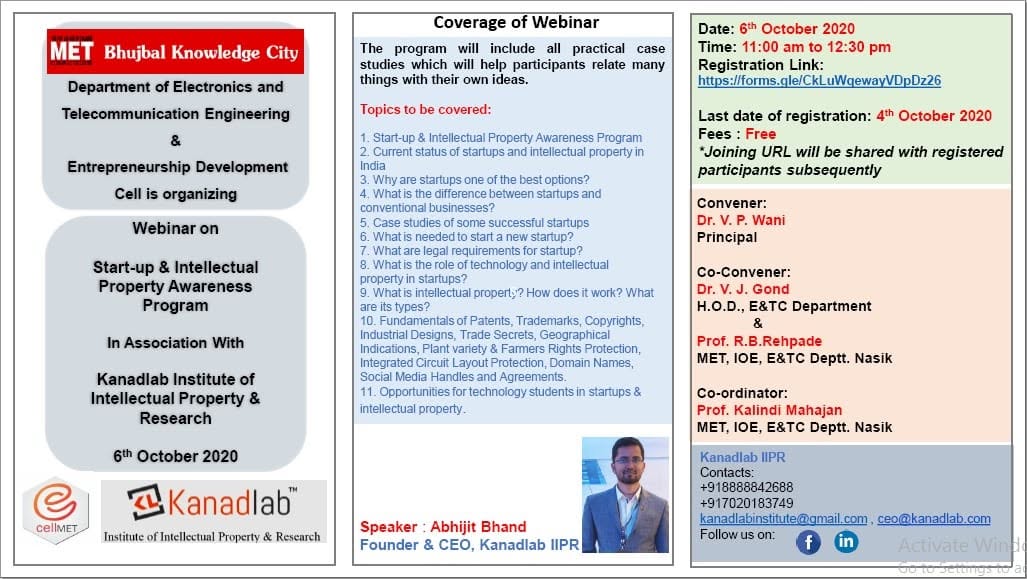
As educational institutions across India increasingly encourage innovation and entrepreneurship, experts believe that technical knowledge alone is no longer sufficient for students aspiring to establish successful enterprises. Understanding markets, identifying commercial opportunities, and protecting intellectual assets have become equally essential in transforming innovative ideas into sustainable businesses. Recognizing this shift in the innovation landscape, the Department of Electronics and Telecommunication Engineering and the Entrepreneurship Development Cell of MET Institute of Engineering, Bhujbal Knowledge City, in association with the Kanadlab Institute of Intellectual Property & Research, organized a webinar on "Start-up & Intellectual Property Awareness Programme." The programme sought to introduce engineering students to the intersection of technology, entrepreneurship, and intellectual property management.
MET Bhujbal Knowledge City has emerged as one of Maharashtra's prominent multidisciplinary educational campuses, consistently promoting innovation, industry interaction, research and entrepreneurial development. Through its Entrepreneurship Development Cell, the institute has been encouraging students to move beyond conventional employment-oriented careers by exploring opportunities in innovation-driven enterprises. The webinar aligned with this vision by introducing participants to the strategic role intellectual property plays throughout the entrepreneurial journey.
Delivering the keynote address, Mr. Abhijit Bhand, Founder & CEO of Kanadlab Institute of Intellectual Property & Research, challenged one of the most common misconceptions among young innovators—that every good idea automatically becomes a successful startup. He explained that entrepreneurship is fundamentally a process of solving real-world problems in a commercially sustainable manner, and intellectual property serves as one of the mechanisms through which innovative solutions can be converted into valuable business assets.
Instead of beginning with legal provisions, Mr. Bhand encouraged participants to examine the lifecycle of innovation itself. He explained that every successful startup begins with identifying a genuine problem rather than developing technology for its own sake. Once a solution demonstrates technical feasibility and commercial relevance, entrepreneurs must evaluate whether different aspects of the innovation can be protected through patents, trademarks, copyrights, industrial designs or confidential business information. This integrated approach, he noted, significantly reduces commercial risk while improving opportunities for scaling the business.
A distinctive feature of the session was its emphasis on startup decision-making rather than intellectual property registration alone. Participants were encouraged to understand why certain innovations should be patented while others may be better protected as trade secrets. Using examples from manufacturing, electronics and software industries, Mr. Bhand demonstrated that businesses often create greater competitive advantages by combining multiple forms of intellectual property rather than relying exclusively on patents.
The discussion also examined why many technically sound startups struggle despite possessing innovative products. According to Mr. Bhand, the failure frequently stems from inadequate market validation, weak branding strategies, absence of commercialization planning, or failure to appreciate the business implications of intellectual property. He emphasized that innovation should always be evaluated through three interconnected perspectives—technical feasibility, commercial viability and legal protectability.
Participants were introduced to the concept of technology readiness and commercialization pathways, highlighting how universities and research institutions across the world increasingly evaluate research not only through academic publications but also through patents, licensing opportunities and startup formation. Mr. Bhand explained that this shift has encouraged educational institutions to establish incubation centres, innovation cells and entrepreneurship development programmes that support students in taking technologies beyond laboratory environments.
Rather than focusing solely on legal rights, the webinar examined intellectual property from an economic perspective. Mr. Bhand explained that intellectual property contributes to reducing investment risk because exclusive rights encourage businesses to invest in research and development. He referred to industries such as biotechnology, semiconductor manufacturing and advanced electronics, where substantial investments would often be commercially impractical without mechanisms protecting technological innovations from immediate imitation.
The programme also explored international innovation trends and India's efforts to strengthen its intellectual property ecosystem. Participants learned how policy initiatives such as the National Intellectual Property Rights Policy and Startup India have attempted to create an environment that supports innovation, technology commercialization and entrepreneurial growth. Mr. Bhand observed that India has witnessed a significant cultural transformation in recent years, with students increasingly viewing entrepreneurship as a viable career option rather than an alternative to employment.
An interesting aspect of the discussion centered on failure in entrepreneurship. Mr. Bhand remarked that unsuccessful startup attempts frequently generate valuable intellectual assets even when businesses do not survive commercially. Technical knowledge, proprietary processes, software, product designs and research outcomes often retain significant value and can be licensed, transferred or incorporated into future ventures. This perspective encouraged participants to view innovation as a continuous learning process rather than a series of isolated commercial successes or failures.
The webinar also highlighted the growing importance of interdisciplinary collaboration. Engineers, management professionals, designers and legal experts, Mr. Bhand explained, increasingly work together throughout the innovation process. Successful commercialization therefore depends not only upon technical excellence but also upon understanding market behaviour, consumer psychology, regulatory requirements and intellectual property strategy. Such collaboration, he observed, has become a defining characteristic of globally competitive innovation ecosystems.
Recognized for his work in intellectual property strategy and innovation advisory, Mr. Bhand encouraged participants to cultivate curiosity, analytical thinking and problem-solving skills rather than focusing exclusively on business formation. He observed that entrepreneurship is ultimately an outcome of sustained innovation, and intellectual property serves as an enabling framework that supports creators in realizing the economic value of their ideas responsibly and sustainably.
The interactive session generated extensive discussion on startup incubation, technology licensing, research funding, protection of engineering projects, ownership of student innovations and opportunities available to first-generation entrepreneurs. Faculty members appreciated the practical orientation of the webinar, noting that it successfully connected engineering education with business strategy and innovation management rather than treating intellectual property as an isolated legal discipline.
The programme concluded with a renewed emphasis on the evolving role of higher educational institutions in India's innovation ecosystem. As universities increasingly encourage students to develop technologies addressing societal challenges, awareness of intellectual property and commercialization strategies is becoming indispensable. Experts believe that initiatives such as these help bridge the longstanding gap between academic innovation and industrial application, ultimately contributing to a stronger culture of entrepreneurship, technology transfer and knowledge-based economic development.