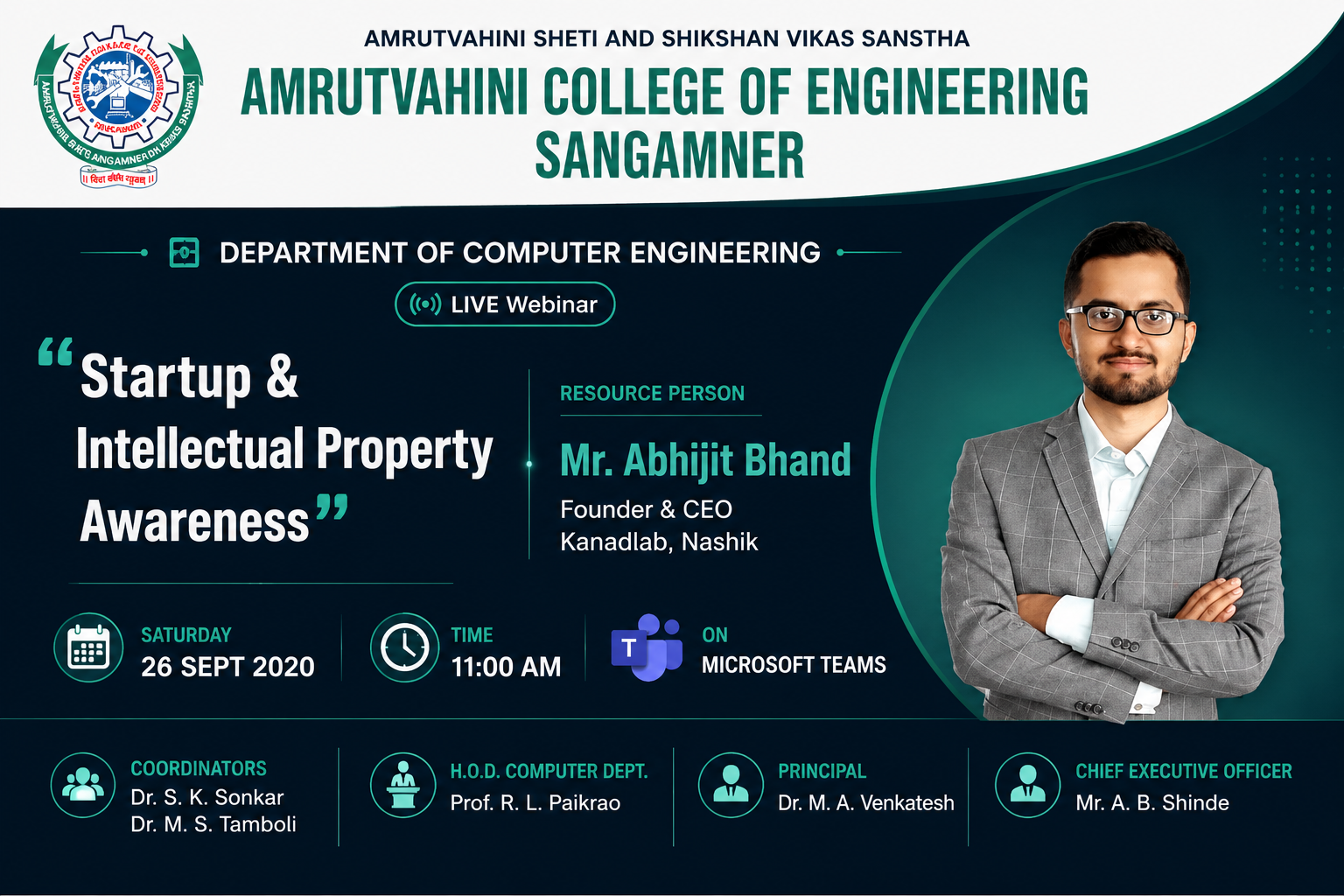
The global economy is increasingly being shaped not by natural resources or manufacturing capacity alone, but by ownership of ideas, algorithms, software, data and digital technologies. As artificial intelligence, cloud computing, cybersecurity and platform-based businesses redefine industries, intellectual property has emerged as one of the most valuable assets in the knowledge economy. For computer engineers, the ability to innovate is no longer enough; understanding how to protect and commercialize technological advancements has become equally important. Recognizing this evolving landscape, the Department of Computer Engineering, Amrutvahini College of Engineering, Sangamner, organized a live webinar on "Startup & Intellectual Property Awareness," bringing together students to explore how engineering innovation can be transformed into sustainable entrepreneurial ventures.
Amrutvahini College of Engineering has earned recognition for promoting technology-oriented education while encouraging students to engage in research, innovation and industry collaboration. As software-driven industries continue to dominate global markets, institutions are increasingly integrating entrepreneurship and intellectual property awareness into technical education. The webinar reflected this broader academic shift by exposing future computer engineers to the legal, commercial and strategic dimensions of technological innovation.
The keynote session was conducted by Mr. Abhijit Bhand, Founder & CEO of Kanadlab Institute of Intellectual Property & Research, who argued that software developers and computer engineers frequently underestimate the economic significance of the intellectual assets they create. Addressing the participants, he remarked that source code, software architecture, user interfaces, databases, machine learning models and proprietary algorithms often become an organization's most valuable resources. Protecting these assets, he explained, requires a nuanced understanding of multiple forms of intellectual property rather than reliance on a single legal mechanism.
Rather than presenting intellectual property as a collection of statutes, Mr. Bhand framed it as an essential component of technology strategy. He explained that modern digital products frequently involve overlapping intellectual property rights. A software platform may contain copyrighted source code, patented technical solutions, trademark-protected branding, registered interface designs and confidential trade secrets relating to algorithms or data processing methods. Successful technology companies, he observed, build competitive advantages by strategically combining these forms of protection rather than depending upon any one of them in isolation.
A major focus of the webinar was the distinction between innovation and invention, a concept often misunderstood by young entrepreneurs. While inventions solve technical problems, innovations generate measurable value by addressing market needs. Mr. Bhand explained that countless technically sophisticated products fail commercially because innovators neglect customer requirements, business models or intellectual property planning. Conversely, relatively simple technologies often achieve remarkable commercial success because they are supported by effective branding, licensing strategies and market positioning.
The discussion also examined the increasingly complex relationship between software and patent law. Unlike traditional mechanical inventions, software innovations frequently involve questions relating to computer programs, algorithms and technical effects. Referring to the evolving legal position in India, Mr. Bhand explained that while computer programs per se are excluded from patentability under the Indian Patents Act, software demonstrating a tangible technical contribution may qualify for protection depending on the nature of the invention. He encouraged students to understand the difference between abstract programming concepts and patentable technical innovations.
Participants were introduced to the role of copyright law in protecting software. Mr. Bhand explained that copyright safeguards the expression of computer code but does not protect underlying ideas, functions or algorithms themselves. This distinction, he noted, has shaped several important international legal disputes. Referring to the landmark Oracle America v. Google litigation, he explained how questions surrounding software interfaces, interoperability and fair use continue to influence software development and digital innovation worldwide. The case demonstrated that intellectual property disputes increasingly involve technological architecture as much as legal interpretation.
The webinar further explored how startups operating in emerging technologies such as artificial intelligence, blockchain, Internet of Things and cybersecurity are transforming the innovation ecosystem. These technologies frequently combine software, hardware and data-driven solutions, creating new challenges regarding ownership, licensing and commercialization. Mr. Bhand observed that engineers entering these domains must develop interdisciplinary competencies that extend beyond programming to include intellectual property strategy, regulatory awareness and business planning.
Another important aspect of the discussion focused on the commercialization of academic software projects. Engineering students often develop innovative applications during hackathons, final-year projects and research activities. However, many such projects fail to progress beyond the academic environment because commercialization planning begins too late. Mr. Bhand encouraged students to evaluate market opportunities, conduct prior-art and technology searches, define ownership arrangements among collaborators and consider licensing options before publicly releasing their innovations.
The session also examined India's growing emphasis on digital entrepreneurship through initiatives such as Digital India, Startup India, and the National Intellectual Property Rights Policy. These programmes, Mr. Bhand explained, have created an environment encouraging technology-driven enterprises by simplifying startup regulations, strengthening innovation infrastructure and promoting awareness of intellectual property. Nevertheless, he cautioned that government initiatives can only support innovators who combine technical competence with strategic planning and continuous learning.
Recognized for his work in innovation management and intellectual property strategy, Mr. Bhand concluded by encouraging participants to view themselves not simply as software developers or engineers but as creators of intellectual assets capable of addressing global challenges. He emphasized that the future competitiveness of Indian technology enterprises will increasingly depend upon their ability to generate original innovations while responsibly protecting and commercializing those innovations in domestic and international markets.
The interactive question-and-answer session witnessed discussions on software patents, open-source licensing, startup incorporation, intellectual property ownership in collaborative coding projects, freelancing, technology transfer and career opportunities in intellectual property consulting. Faculty members observed that the programme successfully connected computer engineering education with entrepreneurship, law and business strategy, offering students a holistic understanding of innovation beyond technical development.
As India strengthens its ambitions to become a global technology and startup powerhouse, educational programmes integrating software engineering with intellectual property awareness are becoming indispensable. Experts believe that nurturing engineers who understand both technology creation and intellectual asset management will significantly enhance the country's ability to build globally competitive digital enterprises and contribute meaningfully to the emerging knowledge economy.