As India aspires to become a global innovation hub, engineering institutions are increasingly expected to produce not only skilled graduates but also innovators capable of developing technologies with commercial and societal impact. While technical education traditionally focused on problem-solving and product development, today's innovation ecosystem demands an additional capability—the ability to identify, protect and leverage intellectual property. Recognizing this shift, the Department of Mechanical Engineering of Guru Gobind Singh College of Engineering and Research Centre (GGSCERC), Nashik, organized a certified awareness programme on "Startup & Intellectual Property Awareness" for engineering students, faculty members and research scholars. Around 400 students participated in this program.
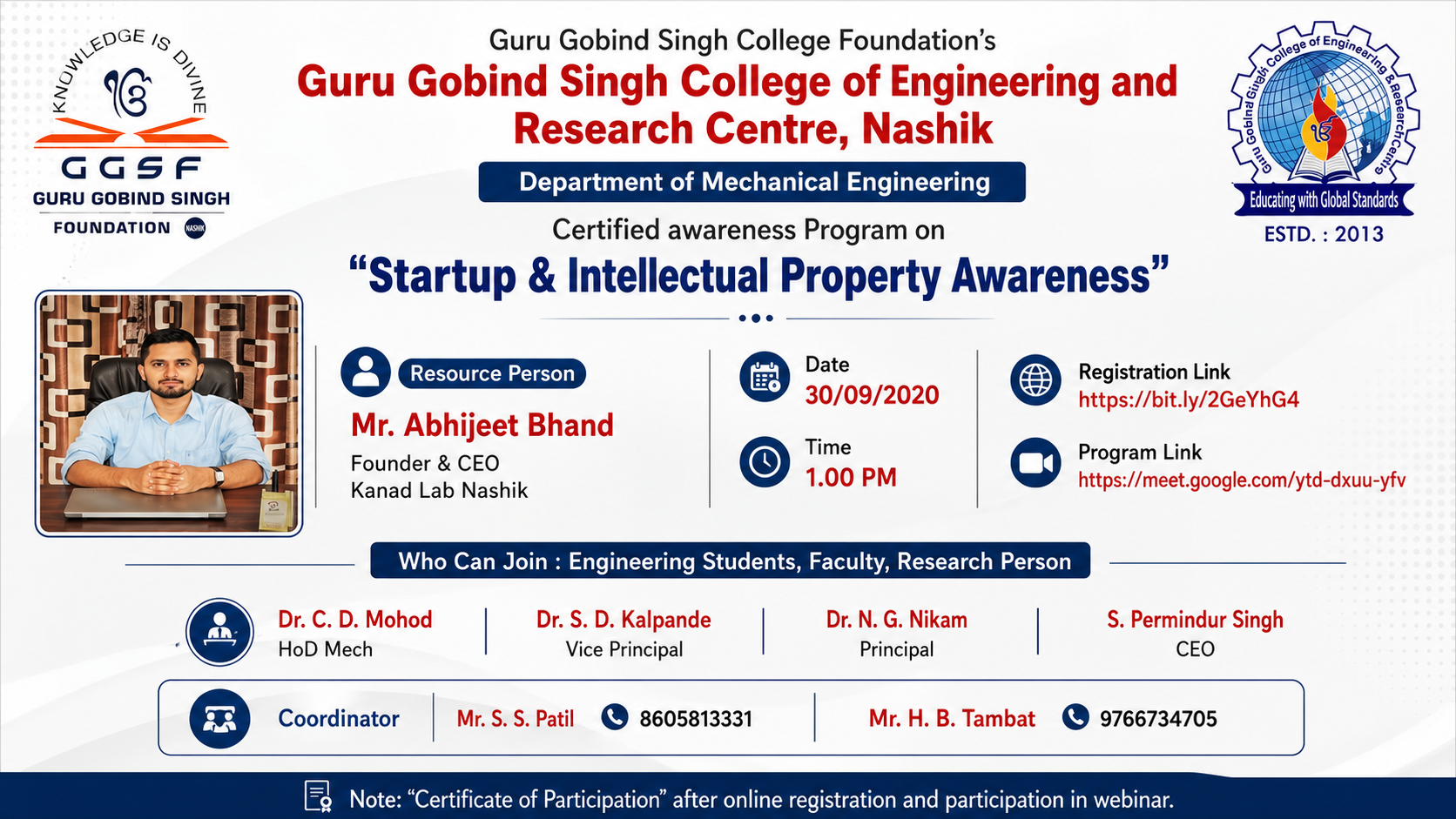
Established under the Guru Gobind Singh College Foundation, the institution has consistently promoted outcome-based engineering education, industry engagement and applied research. The awareness programme formed part of its broader initiative to expose students to emerging dimensions of engineering beyond conventional classroom learning. With entrepreneurship becoming an increasingly viable career pathway for engineering graduates, the programme sought to bridge the gap between technical innovation and business creation through an understanding of intellectual property and commercialization.
The keynote address was delivered by Mr. Abhijit Bhand, Founder & CEO of Kanadlab Institute of Intellectual Property & Research, who urged participants to rethink the conventional perception of engineering education. He observed that an engineer's responsibility extends beyond designing efficient systems or solving technical problems; it also includes ensuring that innovative solutions reach society through sustainable business models. Intellectual property, he explained, provides the legal and commercial framework that enables this transition from laboratory innovation to market-ready technology.
Unlike many introductory discussions on intellectual property that concentrate on statutory provisions, Mr. Bhand approached the subject from the perspective of engineering innovation management. He explained that every engineering project represents a combination of technical creativity, design thinking and problem-solving. However, unless these innovations are systematically documented, evaluated and protected, they often fail to generate long-term value for either the inventor or society.
One of the central themes of the programme was the innovation pipeline within educational institutions. Mr. Bhand explained that colleges today are increasingly expected to contribute to national development not only through teaching but also through research, patents, startup incubation and industry collaboration. He highlighted how many universities across the world have successfully transformed student research into commercially viable technologies through structured technology transfer mechanisms. Indian institutions, he observed, are gradually moving in the same direction with the support of innovation cells, incubation centres and entrepreneurship programmes.
The discussion also explored why intellectual property has become a critical element of modern manufacturing and engineering industries. Referring to sectors such as electric mobility, renewable energy, robotics and advanced materials, Mr. Bhand explained that technological leadership today depends less on production capacity and more on ownership of proprietary technologies. Companies investing heavily in research and development seek intellectual property protection not only to prevent imitation but also to negotiate collaborations, enter international markets and create licensing opportunities.
Participants were introduced to the concept of innovation ecosystems, where universities, startups, industries, investors and government institutions work collaboratively to accelerate technological development. Mr. Bhand explained that intellectual property functions as a common language connecting these stakeholders. Whether a startup seeks investment, a university enters an industrial partnership or a company licenses new technology, the value of innovation is often assessed through the quality and strength of its intellectual property portfolio.
The session further examined India's policy efforts to encourage innovation-led economic growth. Referring to the National Intellectual Property Rights Policy, Mr. Bhand explained that the policy seeks to transform intellectual property from a specialized legal subject into an instrument supporting creativity, entrepreneurship and industrial competitiveness. He also discussed the role of Startup India, which introduced simplified procedures, expedited patent examination and financial incentives to encourage technology-based enterprises. According to him, these initiatives reflect India's broader ambition of strengthening domestic innovation while improving global competitiveness.
Rather than focusing exclusively on patents, the programme highlighted the importance of strategic decision-making in innovation. Participants learned that not every invention necessarily requires patent protection. Depending upon the nature of the technology, businesses may choose trade secret protection, licensing arrangements, collaborative research agreements or defensive publication strategies. Mr. Bhand explained that effective intellectual property management involves selecting the most appropriate protection mechanism after evaluating commercial objectives, technological complexity and market dynamics.
The webinar also introduced students to the concept of patent analytics and its growing relevance in engineering research. Patent databases, he explained, are among the world's largest repositories of technological knowledge and often contain valuable information unavailable in academic journals. Researchers who systematically analyse patent literature can identify technological trends, understand competitor activities, avoid duplication of research and discover opportunities for further innovation. Such analytical approaches, he remarked, are increasingly becoming indispensable for research-intensive institutions and technology companies.
Recognized for his work in intellectual property strategy and innovation management, Mr. Bhand encouraged engineering students to cultivate interdisciplinary thinking by combining technical expertise with commercial awareness. He observed that future engineers would increasingly work in environments where legal knowledge, market intelligence, design innovation and engineering excellence intersect. Developing an understanding of intellectual property therefore enables graduates not only to protect their own innovations but also to participate effectively in technology-driven enterprises.
The interactive session generated thoughtful discussions on patent ownership in collaborative research, commercialization of final-year projects, startup incubation, international patent protection and opportunities for engineering graduates in intellectual property consulting. Faculty members also explored the role educational institutions can play in fostering innovation ecosystems that encourage patenting, entrepreneurship and industry collaboration.
The organizers appreciated the programme for broadening students' understanding of engineering beyond conventional technical education. They noted that intellectual property awareness has become increasingly relevant as educational institutions seek to align research outcomes with national priorities relating to innovation, manufacturing and economic development.
As India moves toward a knowledge-driven economy, programmes integrating engineering education with intellectual property strategy are expected to assume greater significance. Experts believe that empowering young engineers with an understanding of innovation management, commercialization and intellectual property will strengthen the country's capacity to create globally competitive technologies while fostering a culture of responsible and sustainable innovation.