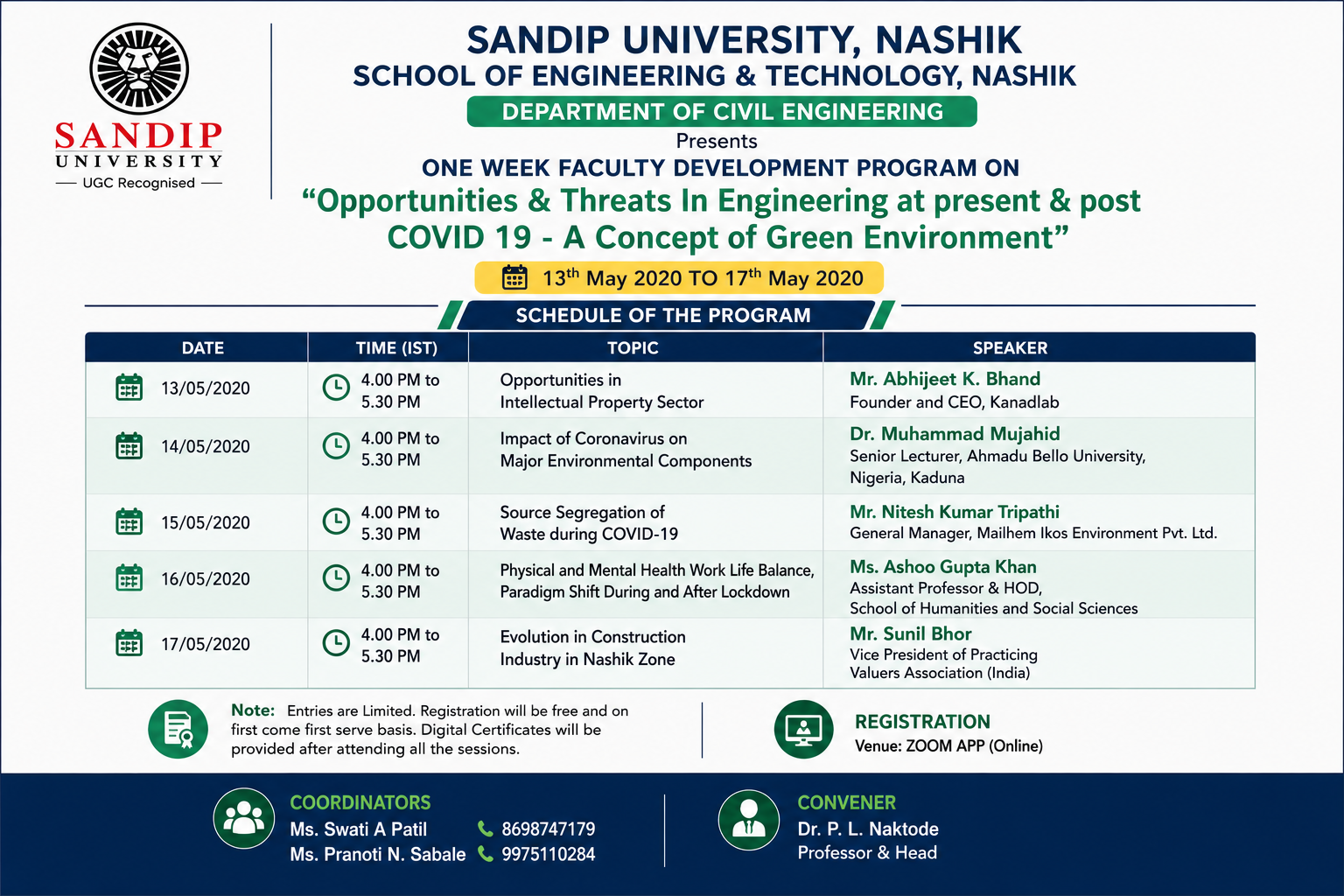
The COVID-19 pandemic disrupted global industries, altered research priorities, and accelerated technological transformation at an unprecedented pace. Engineering institutions across the world were suddenly confronted with new questions concerning sustainability, digital transformation, healthcare innovation and environmental resilience. As governments and industries searched for long-term solutions, it became increasingly evident that the post-pandemic world would demand not only technological ingenuity but also multidisciplinary collaboration between engineers, environmental scientists, policymakers, healthcare experts and innovation professionals. Recognizing this changing landscape, Sandip University's School of Engineering & Technology, through its Department of Civil Engineering, organized a One Week Faculty Development Programme (FDP) titled "Opportunities & Threats in Engineering at Present & Post COVID-19 – A Concept of Green Environment."
The five-day programme attracted more than 240 faculty members, researchers, professionals and students from various institutions, creating an interdisciplinary platform to examine the technological, environmental and societal challenges emerging in the aftermath of the global health crisis. Rather than restricting discussions to a single engineering discipline, the FDP brought together experts from academia, industry and research organizations whose collective expertise ranged from intellectual property and environmental engineering to occupational health, construction management and waste management.
The inaugural technical session featured Mr. Abhijit Bhand, Founder & CEO of Kanadlab Institute of Intellectual Property & Research, who delivered a lecture on "Opportunities in the Intellectual Property Sector." Positioning intellectual property within the broader context of economic recovery and technological advancement, Mr. Bhand argued that crises have historically accelerated innovation. Whether during public health emergencies, climate challenges or industrial transitions, societies that effectively identify, protect and commercialize new technologies are better positioned to recover and compete globally.
Rather than focusing solely on legal procedures surrounding patents, trademarks and copyrights, Mr. Bhand examined the expanding role of intellectual property in shaping innovation ecosystems. He explained that engineering institutions increasingly serve as generators of commercially valuable technologies, making it imperative for faculty members and researchers to understand intellectual property from the earliest stages of research planning. According to him, research publications and patents should not be viewed as competing objectives but as complementary mechanisms through which scientific knowledge contributes both to academic advancement and industrial development.
The session explored how emerging sectors, including renewable energy, medical devices, smart infrastructure, automation and sustainable construction, are increasingly driven by proprietary technologies and research-based entrepreneurship. Mr. Bhand encouraged participants to recognize intellectual property not merely as a legal entitlement but as an instrument capable of attracting research funding, facilitating technology transfer, strengthening university-industry collaboration and accelerating commercialization of engineering innovations.
The discussion also examined the growing significance of patent information as a research resource. Unlike academic journals, patent databases often disclose technological developments years before they appear in conventional scientific literature. Mr. Bhand encouraged researchers to systematically study global patent landscapes before initiating research projects, thereby avoiding duplication of effort while identifying opportunities for novel technological contributions. Such practices, he noted, have become standard among leading research-intensive universities and industrial laboratories worldwide.
Addressing the post-pandemic innovation landscape, Mr. Bhand observed that COVID-19 had highlighted both the strengths and vulnerabilities of global innovation systems. Rapid development of diagnostic technologies, digital healthcare platforms, remote communication tools and medical equipment demonstrated how intellectual property, when appropriately managed alongside collaborative research and public policy, could accelerate technological progress during periods of crisis. He emphasized that future engineers would increasingly be required to balance innovation incentives with broader societal considerations, including sustainability, accessibility and public welfare.
The Faculty Development Programme was deliberately designed to provide participants with diverse perspectives extending well beyond intellectual property. On the second day, Dr. Muhammad Mujahid, Senior Lecturer at Ahmadu Bello University, Kaduna, Nigeria, examined the "Impact of Coronavirus on Major Environmental Components." His presentation analyzed the environmental consequences of the pandemic, discussing temporary improvements in air quality, changing patterns of pollution, and the broader ecological implications of reduced industrial activity. The session encouraged participants to consider how environmental sustainability should remain central to engineering and infrastructure planning even after economic recovery.
The third technical session was delivered by Mr. Nitesh Kumar Tripathi, General Manager at Mailhem Ikos Environment Pvt. Ltd., who addressed the topic "Source Segregation of Waste during COVID-19." Drawing upon industrial experience, he explained how the dramatic increase in biomedical and household waste during the pandemic underscored the need for scientifically designed waste management systems. Participants gained valuable insights into segregation practices, environmental compliance and the responsibilities of engineers in designing sustainable waste management infrastructure capable of responding to future public health emergencies.
Attention subsequently shifted toward the human dimensions of engineering practice through a session by Ms. Ashoo Gupta Khan, Assistant Professor and Head of the School of Humanities and Social Sciences, who discussed "Physical and Mental Health, Work-Life Balance, Paradigm Shift During and After Lockdown." Recognizing that the pandemic fundamentally altered professional and educational environments, she examined the psychological impact of prolonged isolation, remote working arrangements and changing organizational cultures. Her presentation highlighted the importance of resilience, adaptability and employee well-being as integral components of sustainable professional development.
The concluding technical session featured Mr. Sunil Bhor, Vice President of the Practicing Valuers Association (India), who explored the "Evolution in Construction Industry in Nashik Zone." Focusing on regional infrastructure development, he analyzed how the construction sector would need to adapt to changing economic conditions, technological innovations, environmental regulations and post-pandemic operational practices. His presentation offered participants a practical understanding of how engineering industries were preparing for long-term transformation while embracing digital technologies and sustainable construction methodologies.
The multidisciplinary character of the Faculty Development Programme emerged as one of its defining strengths. By bringing together specialists from intellectual property, environmental science, industrial waste management, behavioural sciences and infrastructure development, the programme demonstrated that contemporary engineering challenges cannot be addressed through isolated technical expertise alone. Instead, effective solutions increasingly require collaboration across legal, scientific, environmental, managerial and social disciplines.
Faculty members participating in the programme observed that the discussions provided valuable perspectives extending beyond traditional engineering curricula. Several participants highlighted the relevance of integrating intellectual property awareness, sustainability principles and interdisciplinary collaboration into engineering education to better prepare students for emerging technological and societal challenges.
The organizers noted that the enthusiastic participation of over 240 faculty members, researchers and students reflected the growing recognition that engineering education must continuously evolve in response to rapidly changing global realities. By facilitating dialogue among experts representing diverse fields, the Faculty Development Programme successfully created an academic environment where innovation, sustainability and public policy could be examined collectively rather than independently.
As engineering continues to respond to challenges ranging from climate change and public health to digital transformation and resource management, initiatives such as this Faculty Development Programme underscore the importance of interdisciplinary learning. Experts believe that the future competitiveness of engineering institutions will increasingly depend upon their ability to integrate technological excellence with intellectual property awareness, environmental responsibility, human-centred design and industry collaboration. Sandip University's initiative demonstrated how higher education can serve as a catalyst for preparing engineers and educators capable of leading this transformation in the years ahead.