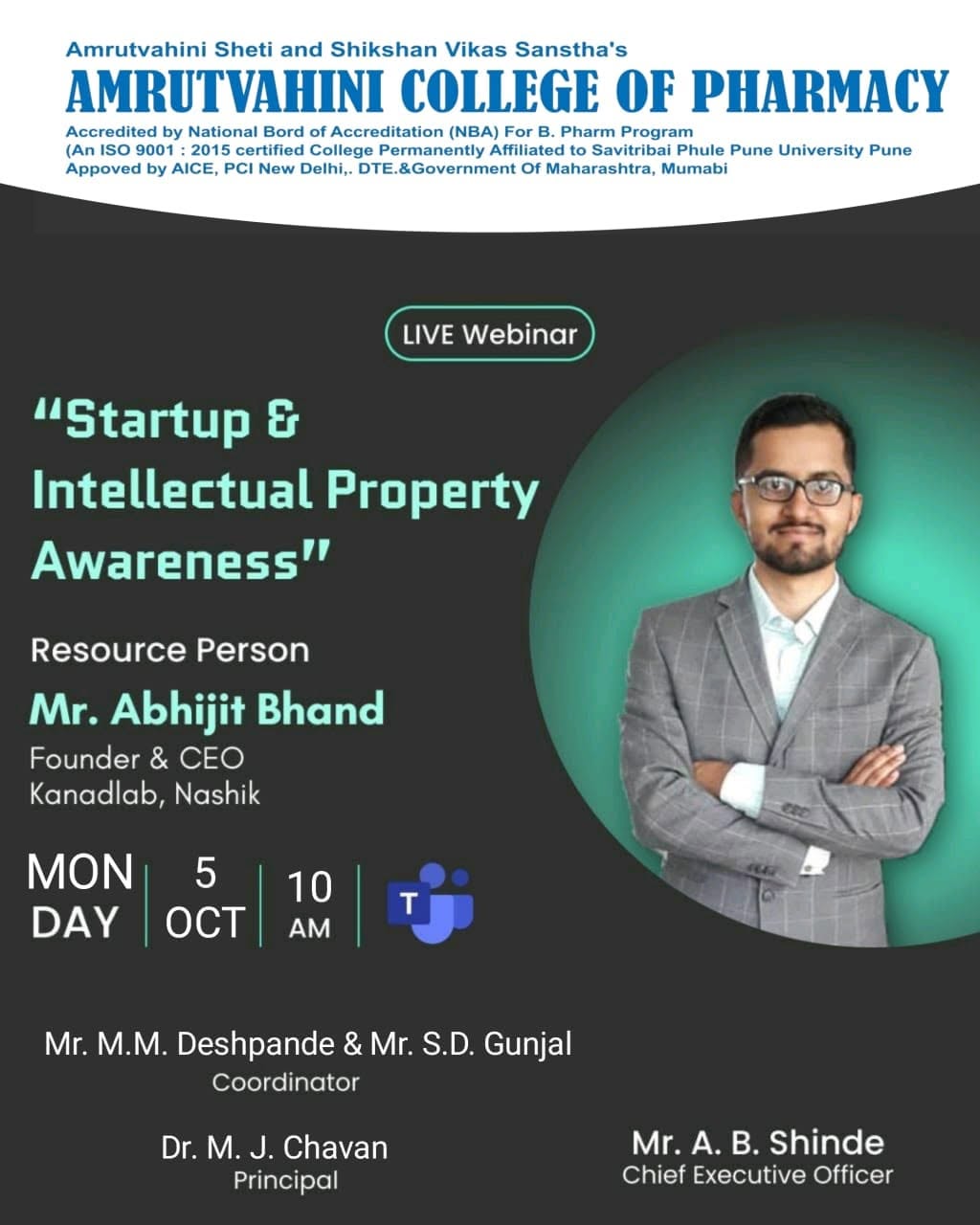
The pharmaceutical industry occupies a unique position in the global innovation landscape. Unlike many other sectors, the journey from laboratory research to a commercially available medicine often spans several years, requires substantial financial investment, and involves rigorous regulatory scrutiny. In such an environment, intellectual property serves not merely as a legal safeguard but as an essential mechanism that enables innovators to recover research investments while encouraging the continuous development of new therapies. Against this backdrop, Amrutvahini College of Pharmacy, Sangamner, organized a live webinar on "Startup & Intellectual Property Awareness", bringing together pharmacy students and young innovators to explore the relationship between scientific research, entrepreneurship and intellectual property protection.
Affiliated with Savitribai Phule Pune University and accredited by the National Board of Accreditation (NBA), Amrutvahini College of Pharmacy has established itself as a centre for pharmaceutical education and research. As India's pharmaceutical sector continues to expand globally, institutions such as Amrutvahini have increasingly focused on nurturing graduates who are not only scientifically competent but also capable of translating research into commercially viable healthcare innovations. The webinar reflected this broader objective by introducing students to the strategic dimensions of intellectual property that extend far beyond conventional legal education.
The keynote session was delivered by Mr. Abhijit Bhand, Founder & CEO of Kanadlab Institute of Intellectual Property & Research, who emphasized that pharmaceutical innovation demands a careful balance between scientific excellence, regulatory compliance and intellectual property strategy. Addressing participants, he observed that while breakthrough discoveries originate in laboratories, their successful translation into products capable of reaching patients depends equally upon effective management of intellectual assets throughout the innovation lifecycle.
Rather than limiting the discussion to patents alone, Mr. Bhand explained how the pharmaceutical industry relies upon multiple forms of intellectual property. Drug formulations, manufacturing processes, packaging designs, proprietary databases, software used in drug development, brand identities and confidential manufacturing know-how each require distinct legal approaches. He encouraged participants to appreciate intellectual property as a comprehensive ecosystem supporting research, commercialization and global competitiveness rather than a single statutory right.
A significant portion of the webinar focused on the economics of pharmaceutical research. Developing a new therapeutic product, Mr. Bhand explained, frequently involves years of experimentation, pre-clinical studies, clinical evaluation and regulatory approvals before reaching the market. Intellectual property protection provides innovators with a limited period of exclusivity during which these substantial investments can potentially be recovered. At the same time, he emphasized that the intellectual property system must also ensure that public health interests are protected by preventing unwarranted monopolies and encouraging competition after statutory protection expires.
The discussion examined India's distinctive approach towards pharmaceutical patent protection, particularly the legislative philosophy embodied in the Patents Act, 1970. Participants were introduced to the rationale behind provisions such as Section 3(d), which seeks to prevent patents for incremental modifications of known pharmaceutical substances unless they demonstrate enhanced therapeutic efficacy. Mr. Bhand explained that this provision has attracted considerable international attention because it attempts to strike a balance between rewarding genuine pharmaceutical innovation and ensuring access to affordable medicines.
To illustrate this balance, the webinar revisited the landmark Novartis AG v. Union of India judgment, widely regarded as one of the most influential patent decisions in Indian legal history. The case highlighted the complexities involved in distinguishing between genuine innovation and incremental modifications intended primarily to extend patent protection. Mr. Bhand observed that the judgment continues to influence discussions on pharmaceutical innovation, public health and intellectual property policy across several jurisdictions.
Moving beyond legal doctrine, the webinar explored how intellectual property influences startup formation within the pharmaceutical and biotechnology sectors. Participants learned that many emerging healthcare enterprises originate from university research laboratories where scientific discoveries are converted into diagnostic technologies, medical devices, formulations or digital health solutions. In such cases, intellectual property becomes indispensable not only for protecting innovation but also for attracting venture capital, securing industrial collaborations and facilitating technology transfer.
The session also examined the increasing convergence of pharmaceutical sciences with digital technologies. Artificial intelligence, computational drug discovery, bioinformatics and personalized medicine are rapidly reshaping healthcare innovation. Mr. Bhand explained that these developments are introducing new intellectual property challenges concerning software, data ownership, AI-assisted inventions and collaborative research. While patent systems worldwide continue to adapt to these technological developments, he encouraged students to cultivate an interdisciplinary understanding combining pharmaceutical science with innovation management and intellectual property strategy.
Participants were further introduced to national initiatives supporting innovation and entrepreneurship. Referring to Startup India, Biotechnology Industry Research Assistance Council (BIRAC) programmes, and the National Intellectual Property Rights Policy, Mr. Bhand observed that India has established an increasingly supportive framework for research commercialization and technology-based enterprises. However, he cautioned that policy support alone cannot substitute for strategic planning. Successful innovators, he remarked, identify commercially valuable intellectual assets at the earliest stages of research and integrate legal protection with product development and business planning.
Recognized for his work in intellectual property strategy, startup advisory and research commercialization, Mr. Bhand encouraged pharmacy students to view themselves not only as future healthcare professionals but also as innovators capable of addressing unmet medical needs through scientific research. He stressed that the future of pharmaceutical innovation will increasingly depend upon collaboration between scientists, clinicians, engineers, entrepreneurs and intellectual property professionals working together to accelerate the journey from discovery to patient care.
The interactive session generated extensive discussion on patent filing for pharmaceutical formulations, protection of herbal and traditional medicine, technology licensing, startup incubation, regulatory pathways and career opportunities in intellectual property. Faculty members noted that the webinar provided participants with a broader understanding of how scientific research, public policy and commercial strategy intersect within the pharmaceutical sector.
The organizers expressed appreciation for the comprehensive nature of the session, observing that it successfully connected pharmaceutical education with contemporary developments in innovation management and entrepreneurship. As India strengthens its position as a global pharmaceutical manufacturing and research hub, educational initiatives that integrate intellectual property awareness with scientific education are expected to play an increasingly important role in preparing the next generation of healthcare innovators.