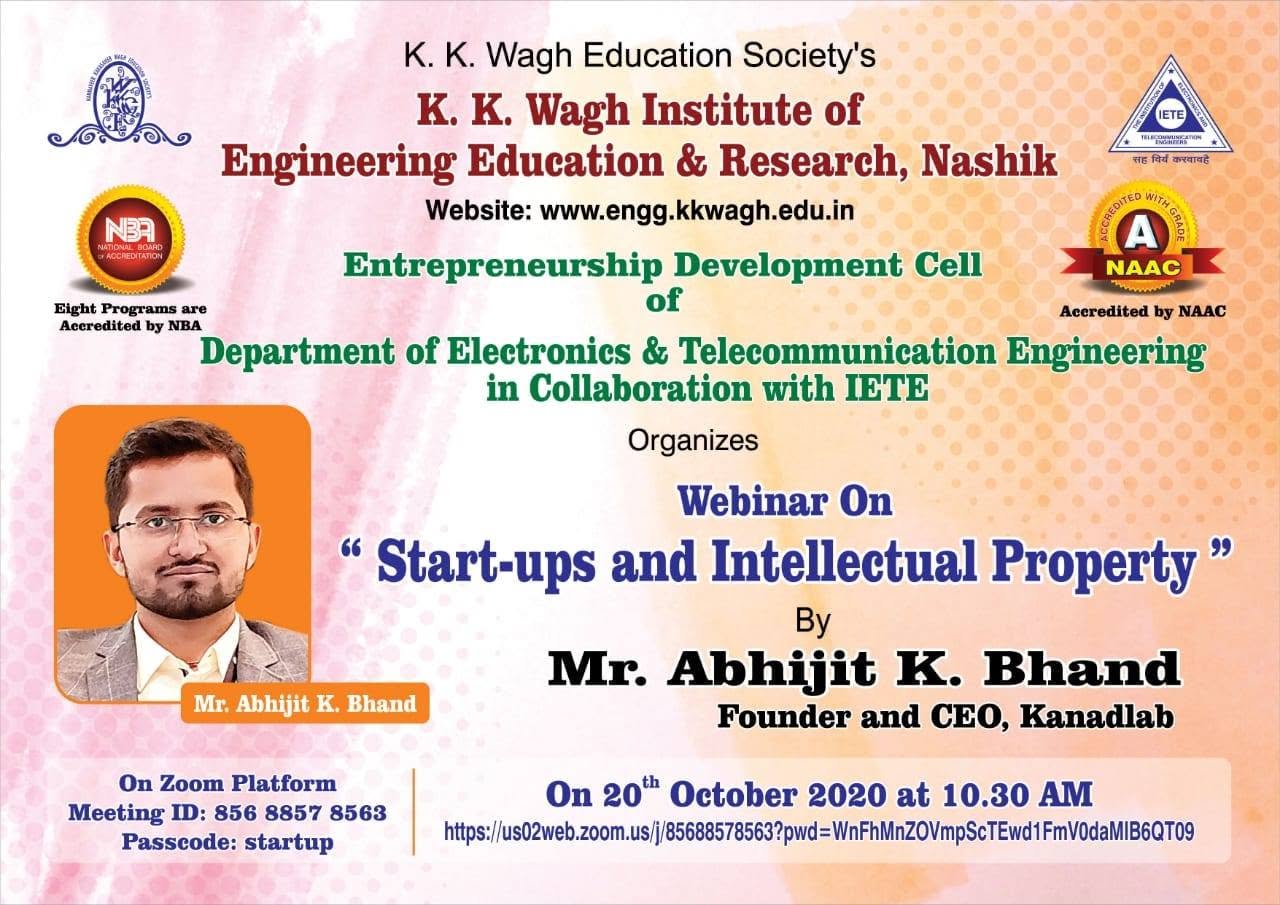
As India steadily transforms into one of the world's fastest-growing startup ecosystems, intellectual property has emerged as a decisive factor in determining whether innovative ideas evolve into sustainable enterprises or remain unrealized concepts. While engineering institutions increasingly encourage students to develop prototypes and participate in innovation competitions, experts believe that the ability to identify, protect and commercialize intellectual assets has become equally important. Against this backdrop, the Entrepreneurship Development Cell of the Department of Electronics & Telecommunication Engineering, K.K. Wagh Institute of Engineering Education & Research (KKWIEER), Nashik, in collaboration with the Institution of Electronics and Telecommunication Engineers (IETE), organized a webinar on "Start-ups and Intellectual Property." The programme witnessed the participation of 230 students, reflecting the growing interest among engineering students in innovation-driven entrepreneurship.
K.K. Wagh Institute of Engineering Education & Research is among Maharashtra's leading engineering institutions, recognized for promoting research, entrepreneurship and industry engagement alongside technical education. Through its Entrepreneurship Development Cell, the institute has consistently encouraged students to transform academic projects into commercially viable technologies. The webinar formed part of this broader effort to equip future engineers with the legal and strategic understanding required to compete in an increasingly knowledge-based economy.
The session was delivered by Mr. Abhijit Bhand, Founder & CEO of Kanadlab Institute of Intellectual Property & Research, who emphasized that intellectual property should no longer be perceived as a legal formality but as a strategic business resource. Addressing the participants, he observed that the value of modern enterprises increasingly lies in intangible assets rather than physical infrastructure. Patents, trademarks, copyrights, industrial designs and trade secrets, he explained, collectively determine a company's ability to innovate, attract investment and establish long-term competitive advantage.
During the presentation, Mr. Bhand introduced participants to the fundamentals of the intellectual property system while demonstrating its practical relevance to engineering students and aspiring entrepreneurs. He explained that a single startup may simultaneously own several forms of intellectual property—a patented technology, a trademark protecting its brand identity, copyright in software and technical documentation, industrial design protection for product aesthetics, and trade secrets safeguarding confidential manufacturing processes or algorithms. Strategic management of these assets, he noted, can substantially enhance enterprise value and market position.
The discussion also examined India's rapidly evolving innovation ecosystem and the policy measures introduced to encourage technology-based entrepreneurship. Referring to the Startup India Action Plan, Mr. Bhand highlighted how the Government of India has simplified patent filing procedures, introduced substantial fee concessions for recognized startups, and provided access to facilitators to assist innovators in securing patent protection. These reforms, coupled with the National Intellectual Property Rights Policy, 2016, have sought to strengthen India's innovation capacity by making intellectual property more accessible to researchers, educational institutions and emerging enterprises.
Explaining why patents have become indispensable for technology startups, Mr. Bhand observed that investors increasingly evaluate the quality of a startup's intellectual property portfolio before making investment decisions. A well-protected invention, he remarked, not only prevents competitors from copying innovative products but also enhances credibility during fundraising, licensing negotiations and strategic partnerships. He encouraged students to view patents as instruments for commercialization rather than merely certificates of legal ownership.
To illustrate the commercial importance of intellectual property, the session examined the long-running Apple–Samsung litigation, one of the most influential patent and design disputes in the global technology industry. The case demonstrated how intellectual property rights can shape market competition, influence product development strategies and affect corporate valuation. Participants were encouraged to appreciate that intellectual property disputes frequently involve not only legal questions but also significant commercial and technological implications.
The webinar further explored common challenges faced by first-generation entrepreneurs. Mr. Bhand cautioned that many innovators unintentionally compromise their intellectual property by publicly disclosing inventions through project exhibitions, technical papers or startup competitions before filing patent applications. Since patent law requires an invention to be novel, premature disclosure may destroy patentability in many jurisdictions. He therefore encouraged students to integrate intellectual property planning into the earliest stages of research and product development.
Recognized for his work in intellectual property strategy, startup advisory and innovation management, Mr. Bhand emphasized that successful entrepreneurs distinguish themselves not only by creating innovative technologies but also by protecting and managing them effectively. He explained that intellectual property should be treated as a core business asset influencing valuation, competitiveness, technology transfer and long-term sustainability. According to him, integrating intellectual property strategy with engineering design and business planning enables startups to transform technical innovations into commercially successful enterprises.
Participants also engaged in discussions on technology transfer, licensing, collaborative research and commercialization of academic innovations. The session highlighted the increasing role of educational institutions in nurturing startup ecosystems by encouraging patent filing, incubation support and industry collaboration. Students were informed about the opportunities available through government-supported innovation initiatives and were encouraged to explore entrepreneurship as a viable career pathway alongside conventional employment.
The interactive session witnessed enthusiastic participation from the 230 students, who raised questions on patent filing procedures, ownership of student-developed technologies, software protection, startup incorporation and commercialization strategies. The practical orientation of the programme helped participants understand that intellectual property is closely linked with engineering design, product development and business strategy rather than being confined to legal practice.
The organizers expressed their appreciation to Mr. Bhand for delivering an insightful session that successfully connected engineering education with entrepreneurship and intellectual property management. They noted that the webinar reinforced the institution's commitment to promoting innovation-led learning and preparing students for the demands of the knowledge economy.
As India's innovation landscape continues to evolve, educational initiatives that integrate entrepreneurship with intellectual property awareness are becoming increasingly significant. Experts believe that equipping young innovators with an understanding of intellectual property at an early stage not only encourages responsible innovation but also strengthens the country's ability to transform research outcomes into globally competitive technologies and sustainable enterprises.