With startups emerging as key drivers of economic growth and technological advancement, the Institute of Management & Research (IMR), Jalgaon, under the Khandesh College Education Society (KCES), organized a workshop on "Start-up & Intellectual Property" to promote innovation and entrepreneurial thinking among students. The programme also marked the inauguration of the IMR Research & Innovation Cell, a significant initiative aimed at strengthening the institution's research ecosystem and fostering industry-oriented innovation.
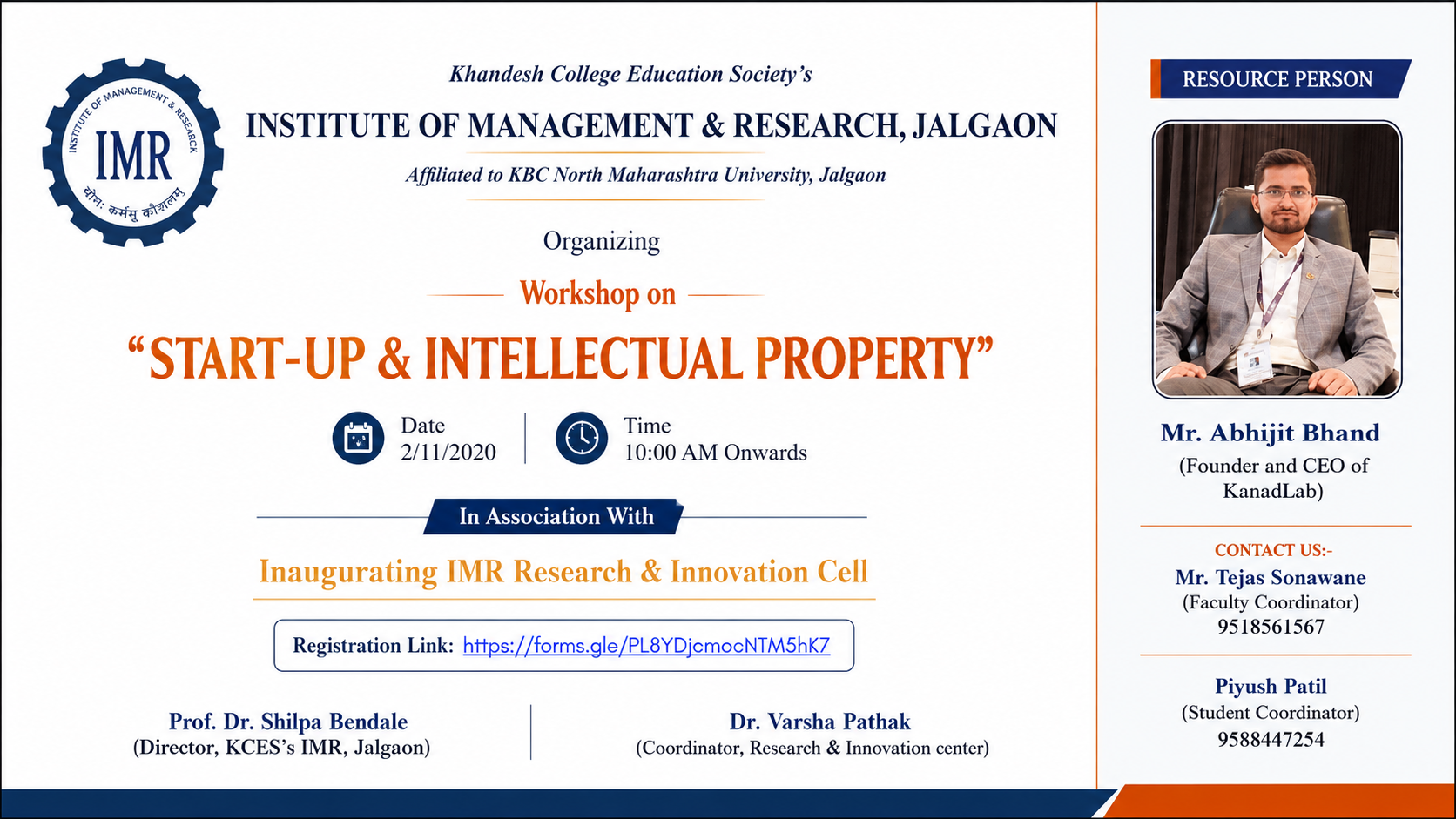
The workshop featured Mr. Abhijit Bhand, Founder & CEO of Kanadlab Institute of Intellectual Property & Research, as the resource person. Addressing management students, aspiring entrepreneurs, researchers, and faculty members, Mr. Bhand highlighted the indispensable role of intellectual property (IP) in transforming innovative ideas into commercially viable enterprises. He remarked that while many startups focus on product development and fundraising, the long-term success of an innovation-driven business often depends on how effectively it protects and manages its intellectual assets.
During the session, participants were introduced to the strategic role of patents, trademarks, copyrights, industrial designs, and trade secrets in startup development. Mr. Bhand explained that intellectual property should not be viewed merely as a legal safeguard but as a business asset capable of attracting investment, creating market differentiation, facilitating licensing opportunities, and enhancing enterprise valuation. He emphasized that investors increasingly evaluate startups based on the strength of their intellectual property portfolio alongside their business model and technological capabilities.
Referring to India's rapidly expanding startup ecosystem, Mr. Bhand discussed several government initiatives designed to promote innovation, including the Startup India Action Plan, the National IPR Policy, 2016, and schemes supporting patent filing for startups and educational institutions. He explained how recognized startups benefit from substantial rebates in patent filing fees, access to government-appointed facilitators, and expedited examination of patent applications, making intellectual property protection more accessible to first-generation entrepreneurs.
To illustrate the commercial significance of intellectual property, Mr. Bhand presented examples of startups whose innovations became valuable business assets because of effective IP management. He explained how companies built around proprietary technologies, software platforms, and innovative products often derive a significant portion of their market valuation from intangible assets rather than physical infrastructure. The discussion highlighted that in today's knowledge economy, patents and trademarks frequently determine a company's competitiveness and investment potential.
The workshop also examined important legal developments that have influenced India's innovation landscape. Participants discussed the landmark Novartis AG v. Union of India judgment, where the Supreme Court interpreted Section 3(d) of the Indian Patents Act to prevent patents on incremental pharmaceutical modifications lacking enhanced therapeutic efficacy. The case was presented as an example of India's effort to strike a balance between encouraging genuine innovation and ensuring affordable access to medicines.
Recognizing the audience's entrepreneurial interests, Mr. Bhand addressed several practical issues faced by startups during their early stages, including ownership of inventions among co-founders, confidentiality agreements, technology licensing, trademark selection, branding strategies, and commercialization of research. He emphasized the importance of conducting prior art searches before product development and filing appropriate intellectual property applications before publicly disclosing innovations to avoid losing valuable legal rights.
The session also explored the increasing role of universities in fostering innovation and entrepreneurship. Speaking during the inauguration of the IMR Research & Innovation Cell, Mr. Bhand observed that higher educational institutions are gradually evolving into innovation hubs where research outcomes are expected not only to contribute to academic knowledge but also to generate commercially relevant technologies and startup opportunities. He encouraged students to view research, entrepreneurship, and intellectual property as interconnected pillars of sustainable economic development.
Known for his work in promoting intellectual property awareness across academic, industrial, and entrepreneurial ecosystems, Mr. Abhijit Bhand underscored the need to integrate intellectual property strategy into business decision-making from the very inception of an idea. He remarked that in today's knowledge-driven economy, innovation without adequate intellectual property protection often translates into lost opportunities, enabling competitors to benefit from original ideas without making comparable investments in research and development.
The programme witnessed active participation from students and faculty members, who engaged in discussions on startup funding, patent filing procedures, trademark registration, technology commercialization, and career opportunities in intellectual property. The interactive nature of the workshop enabled participants to appreciate the practical application of intellectual property law beyond legal compliance, particularly in entrepreneurship and business management.
The organizers expressed their appreciation to Mr. Bhand for delivering an insightful and industry-oriented session while congratulating the newly established IMR Research & Innovation Cell on its inauguration. They noted that such initiatives would strengthen the institution's innovation ecosystem by encouraging research, protecting intellectual assets, and promoting entrepreneurial culture among students.