Recognizing the increasing importance of innovation, emerging technologies, and interdisciplinary learning in engineering education, S. B. Patil College of Engineering, Indapur, organized a Two-Day National Level Online Student Development Programme – "Knowledge Fair-2K20" in association with the Institution's Innovation Council (IIC) and the Career Education Cell (CEC). The programme brought together distinguished experts from academia, industry, government, and international organizations to share their experiences and guide students on emerging career opportunities.
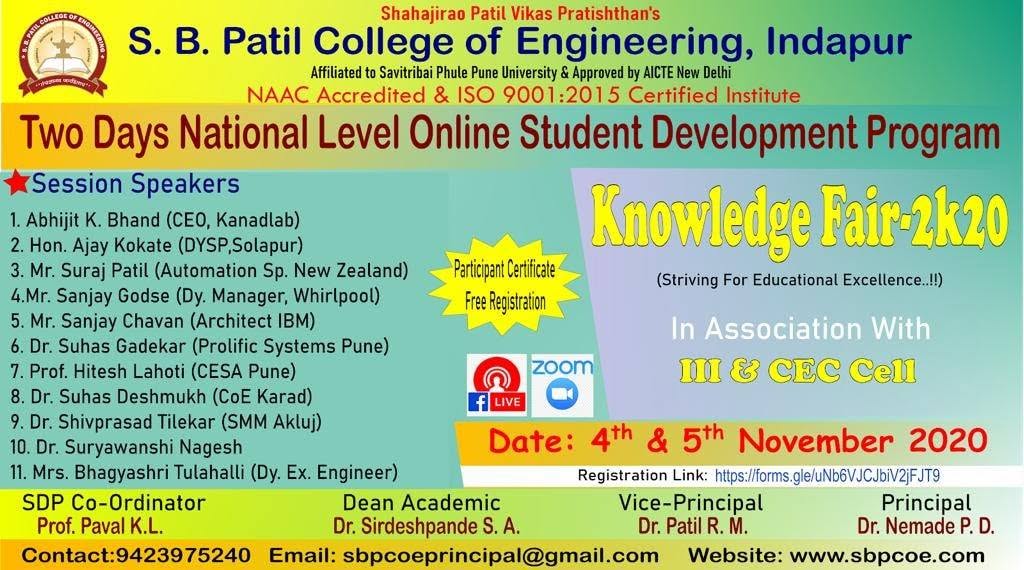
Among the keynote speakers was Mr. Abhijit Bhand, Founder & CEO of Kanadlab Institute of Intellectual Property & Research, who addressed participants on the growing significance of Intellectual Property Rights (IPR) in engineering, research, innovation, and entrepreneurship. Speaking to students from various disciplines, Mr. Bhand emphasized that in today's knowledge-driven economy, intellectual property has become one of the most valuable assets for individuals, startups, research institutions, and technology companies.
During his address, Mr. Bhand explained that innovation does not conclude with developing a novel idea or prototype; rather, it reaches its true potential only when it is effectively protected, managed, and commercialized. He introduced participants to the various forms of intellectual property, including patents, trademarks, copyrights, industrial designs, trade secrets, and geographical indications, illustrating how each serves a distinct purpose in safeguarding innovation and creating sustainable competitive advantages.
Highlighting the transformation of India's innovation ecosystem, he discussed several initiatives undertaken by the Government of India, including the Startup India Action Plan, National IPR Policy, 2016, Atal Innovation Mission, and support mechanisms established by DPIIT to encourage patent filing, technology commercialization, and startup development. He observed that India's rapidly expanding startup ecosystem presents immense opportunities for young engineers, provided they integrate intellectual property strategy into the innovation process from the very beginning.
The session featured several practical examples demonstrating the commercial value of intellectual property. Participants learned how global technology companies build extensive patent portfolios to secure competitive advantages, negotiate licensing agreements, and attract investment. At the same time, Mr. Bhand explained that intellectual property protection is equally important for student innovators and early-stage startups, where a single invention or proprietary technology may become the foundation of an entire enterprise.
The discussion also examined notable legal developments and policy debates that have shaped intellectual property law. Referring to the landmark Novartis AG v. Union of India decision, Mr. Bhand explained how Section 3(d) of the Indian Patents Act reflects India's approach of encouraging genuine innovation while preventing the practice of "evergreening" pharmaceutical patents. He further discussed how the COVID-19 pandemic renewed international debates on patent protection, access to medicines, and the balance between innovation incentives and public health, demonstrating that intellectual property law frequently intersects with economics, public policy, and global development.
Encouraging students to think beyond conventional career paths, Mr. Bhand highlighted the growing demand for professionals with expertise at the intersection of technology, law, and business. He emphasized that engineers with an understanding of intellectual property are increasingly sought after in research organizations, multinational corporations, technology transfer offices, startups, and innovation consultancies.
Drawing upon his extensive experience in intellectual property law and innovation management, Mr. Bhand shared practical insights into integrating intellectual property strategy with business planning from the earliest stages of product development. Widely recognized for his work in patent prosecution, startup advisory, and intellectual property education, he emphasized that successful enterprises view intellectual property not merely as a legal safeguard but as a strategic business asset. He observed that many promising startups lose their competitive advantage by delaying intellectual property protection until after entering the market.
The interactive session witnessed enthusiastic participation from engineering students across the country, who raised questions regarding patent filing procedures, ownership of student innovations, software patents, commercialization strategies, and career prospects in intellectual property. Participants appreciated the practical approach adopted during the session, which successfully connected legal principles with real-world engineering and entrepreneurial challenges.
The organizers expressed their gratitude to all distinguished speakers for contributing to the success of Knowledge Fair-2K20, noting that the programme provided students with valuable insights into technological advancements, professional development, innovation management, and intellectual property. The event concluded with a renewed emphasis on nurturing innovation-driven talent capable of contributing to India's evolving knowledge economy.