In an initiative to strengthen innovation and intellectual property awareness among young innovators, the Institution's Innovation Council (IIC) of K.R.T. Arts, B.H. Commerce and A.M. Science (KTHM) College, Nashik, organized a webinar on "Identifying Intellectual Property Component at the Early Stage of Innovation." The programme, conducted under the Ministry of Education's Institution's Innovation Council initiative, witnessed enthusiastic participation from 189 students, along with faculty members, researchers, and aspiring entrepreneurs.
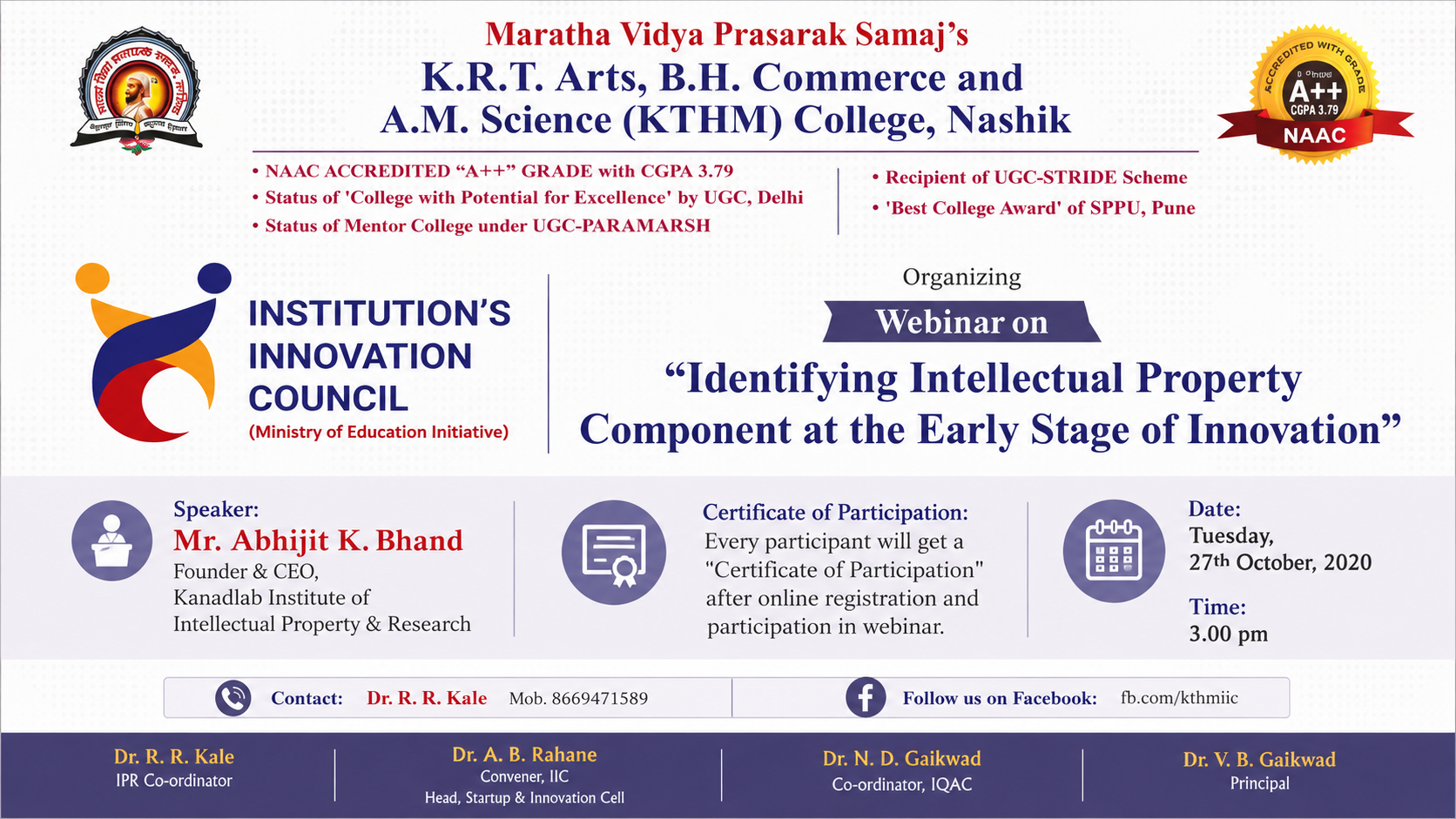
The webinar was delivered by Mr. Abhijit Bhand, Founder & CEO of Kanadlab Institute of Intellectual Property & Research, who highlighted the importance of identifying protectable intellectual assets at the earliest stages of research and innovation. Addressing the participants, Mr. Bhand observed that one of the most common reasons innovators lose valuable intellectual property rights is their inability to recognize inventions, creative works, and commercially valuable ideas before publicly disclosing them through presentations, publications, competitions, or social media.
Beginning with an overview of India's innovation ecosystem, Mr. Bhand explained that intellectual property should not be viewed as an afterthought but as an integral part of the innovation lifecycle. He introduced participants to the different forms of intellectual property, including patents, trademarks, copyrights, industrial designs, trade secrets, and geographical indications, explaining how each protects a distinct category of innovation. He emphasized that selecting the appropriate form of protection is often as important as developing the innovation itself.
A major focus of the webinar was helping students understand how to identify intellectual property embedded within academic projects, research work, software applications, product prototypes, creative content, and entrepreneurial ideas. Through practical examples, Mr. Bhand demonstrated that a single innovation may contain multiple forms of intellectual property. For instance, while an innovative device may be protected through a patent, its brand name can be registered as a trademark, its external appearance protected as an industrial design, the accompanying software may attract copyright protection, and confidential manufacturing processes may qualify as trade secrets.
The session also addressed one of the most critical mistakes made by researchers and innovators, premature public disclosure. Mr. Bhand explained that presenting an invention at conferences, publishing research papers, uploading technical details online, or demonstrating prototypes before filing a patent application may destroy the novelty required for patent protection in many jurisdictions. He encouraged participants to consult intellectual property professionals and institutional innovation cells before making public disclosures, thereby preserving opportunities for future commercialization.
Using notable case studies, Mr. Bhand illustrated how strategic identification and protection of intellectual property have transformed innovative ideas into globally successful businesses. He discussed how companies such as Dyson built competitive advantages through strong patent portfolios protecting engineering innovations, while technology companies like Apple have strategically combined patents, industrial designs, trademarks, and copyrights to create comprehensive intellectual property protection around their products. These examples helped participants understand that intellectual property is not limited to legal documentation but plays a central role in business strategy and market competitiveness.
The webinar also explored India's evolving intellectual property framework and policy initiatives supporting innovation. Participants were introduced to the National IPR Policy, 2016, Startup India, the Atal Innovation Mission, and various government schemes encouraging patent filing by startups and educational institutions. Mr. Bhand emphasized that universities and colleges are increasingly expected to generate not only academic publications but also technologies capable of commercialization, startup creation, and societal impact.
Recognized for his contributions to intellectual property awareness and innovation management, Abhijit Bhand encouraged students to adopt an innovation mindset that integrates legal, technical, and commercial considerations from the very beginning of every project. He explained that protecting intellectual property at an early stage significantly improves opportunities for securing research funding, attracting investors, licensing technologies, and building successful startups. According to him, the most valuable intellectual property strategy is one that begins long before an invention reaches the marketplace.
The interactive session witnessed active participation from the 189 students, who raised questions regarding patentability of engineering projects, software protection, ownership of student innovations, commercialization pathways, startup incubation, and career opportunities in intellectual property. The engaging discussions reflected the growing awareness among students regarding the importance of protecting and leveraging intellectual assets in today's knowledge-driven economy.
The organizers appreciated the overwhelming response to the webinar and thanked Mr. Bhand for delivering a highly informative and application-oriented session. They noted that the programme successfully aligned with the objectives of the Institution's Innovation Council, which seeks to cultivate innovation, entrepreneurship, and intellectual property awareness among students across higher educational institutions. The webinar concluded with a renewed commitment to fostering a culture where innovation is not only encouraged but also strategically protected and transformed into valuable intellectual assets.