With intellectual property emerging as a critical component of innovation, research, and the digital economy, the Department of Computer Engineering of Karmaveer Adv. Baburao Ganpatrao Thakare College of Engineering (KBTCOE), Nashik, organized a three-day workshop on Intellectual Property Rights (IPR) under the aegis of the Internal Quality Assurance Cell (IQAC). The workshop was designed to introduce students and faculty members to the legal, technological, and commercial aspects of intellectual property and its growing importance in engineering education and research.
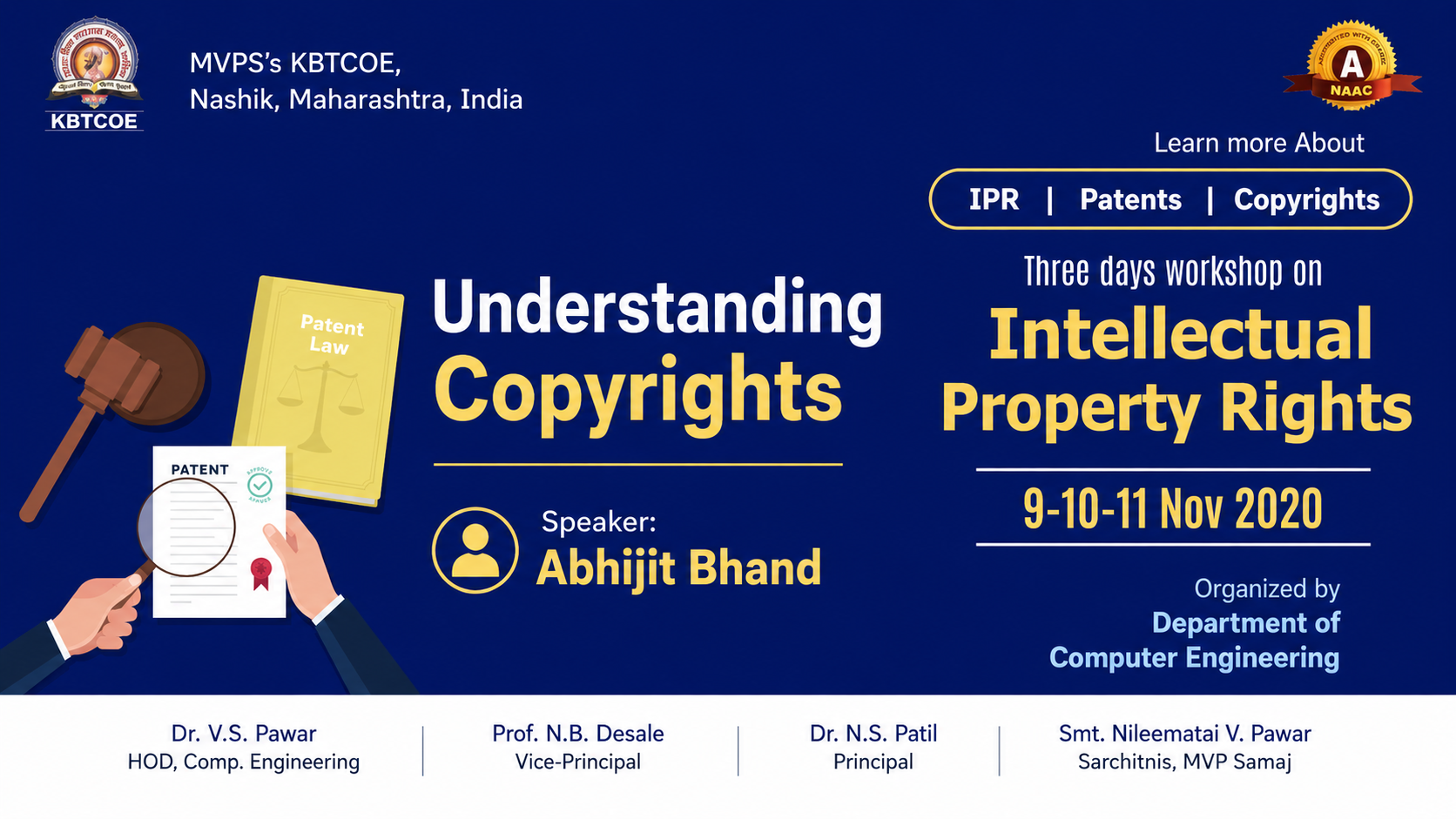
The workshop featured Mr. Abhijit Bhand, Founder & CEO of Kanadlab Institute of Intellectual Property & Research, as the keynote resource person for a series of technical sessions. During the programme, he addressed participants on multiple aspects of intellectual property, with a dedicated session on "Understanding Copyrights", focusing on the legal protection of creative and digital works in the rapidly evolving information age.
Opening his address, Mr. Bhand explained that while patents often receive significant attention in engineering institutions, copyright remains one of the most widely misunderstood forms of intellectual property, despite affecting almost every student, researcher, software developer, and educator. He emphasized that computer programs, research publications, presentations, technical reports, websites, photographs, videos, architectural drawings, databases, and multimedia content are all capable of attracting copyright protection under the Copyright Act, 1957, provided they satisfy the requirement of originality.
During the session, participants were introduced to the distinction between ideas and expressions, one of the fundamental principles of copyright law. Mr. Bhand explained that copyright protects the original expression of an idea rather than the idea itself. Using practical examples from software development, academic writing, and digital content creation, he demonstrated how two individuals may independently develop similar concepts while only the original expression embodied in source code, documentation, artistic works, or written material receives copyright protection.
The workshop also explored several landmark copyright disputes that have shaped intellectual property jurisprudence worldwide. Referring to the long-standing litigation between Oracle and Google concerning the use of Java APIs, Mr. Bhand discussed how copyright law continues to evolve alongside technological innovation, particularly in the software industry. The discussion illustrated the delicate balance courts must maintain between protecting creators' rights and encouraging technological interoperability and innovation.
Recognizing the widespread use of online educational resources, participants were also introduced to issues relating to plagiarism, fair dealing, open-source software licensing, Creative Commons licences, digital piracy, and academic integrity. Mr. Bhand observed that while digital technologies have made knowledge more accessible than ever before, they have simultaneously increased instances of unauthorized copying and misuse of copyrighted works. He encouraged students to develop ethical practices in using third-party materials while respecting the intellectual efforts of authors, researchers, and creators.
The session further highlighted the intersection of copyright with emerging technologies such as artificial intelligence, software development, and digital content creation. Participants discussed contemporary debates surrounding AI-generated works and the challenges faced by existing copyright frameworks in determining authorship and ownership of machine-generated content. These discussions encouraged students to appreciate that intellectual property law continues to evolve alongside technological progress.
Beyond copyright, the three-day workshop provided a comprehensive overview of the Indian intellectual property ecosystem, covering patents, trademarks, industrial designs, geographical indications, and strategic intellectual property management. Participants learned how intellectual property contributes to research commercialization, startup development, technology transfer, and innovation-led economic growth. Government initiatives such as the National IPR Policy, Startup India, and support mechanisms for innovators were also discussed, emphasizing India's efforts to strengthen its innovation ecosystem.
The workshop witnessed enthusiastic participation from engineering students and faculty members, who actively engaged in discussions on software copyrights, ownership of academic research, patent filing procedures, commercialization opportunities, and career prospects in the field of intellectual property. Participants appreciated the programme for combining legal concepts with practical examples relevant to engineering education and the technology industry.
The organizers expressed their gratitude to Mr. Bhand for delivering an informative and engaging series of sessions that successfully bridged the gap between technical education and intellectual property law. The workshop concluded with a renewed emphasis on fostering an innovation-oriented culture in higher education, where research excellence is complemented by effective protection and responsible management of intellectual property.