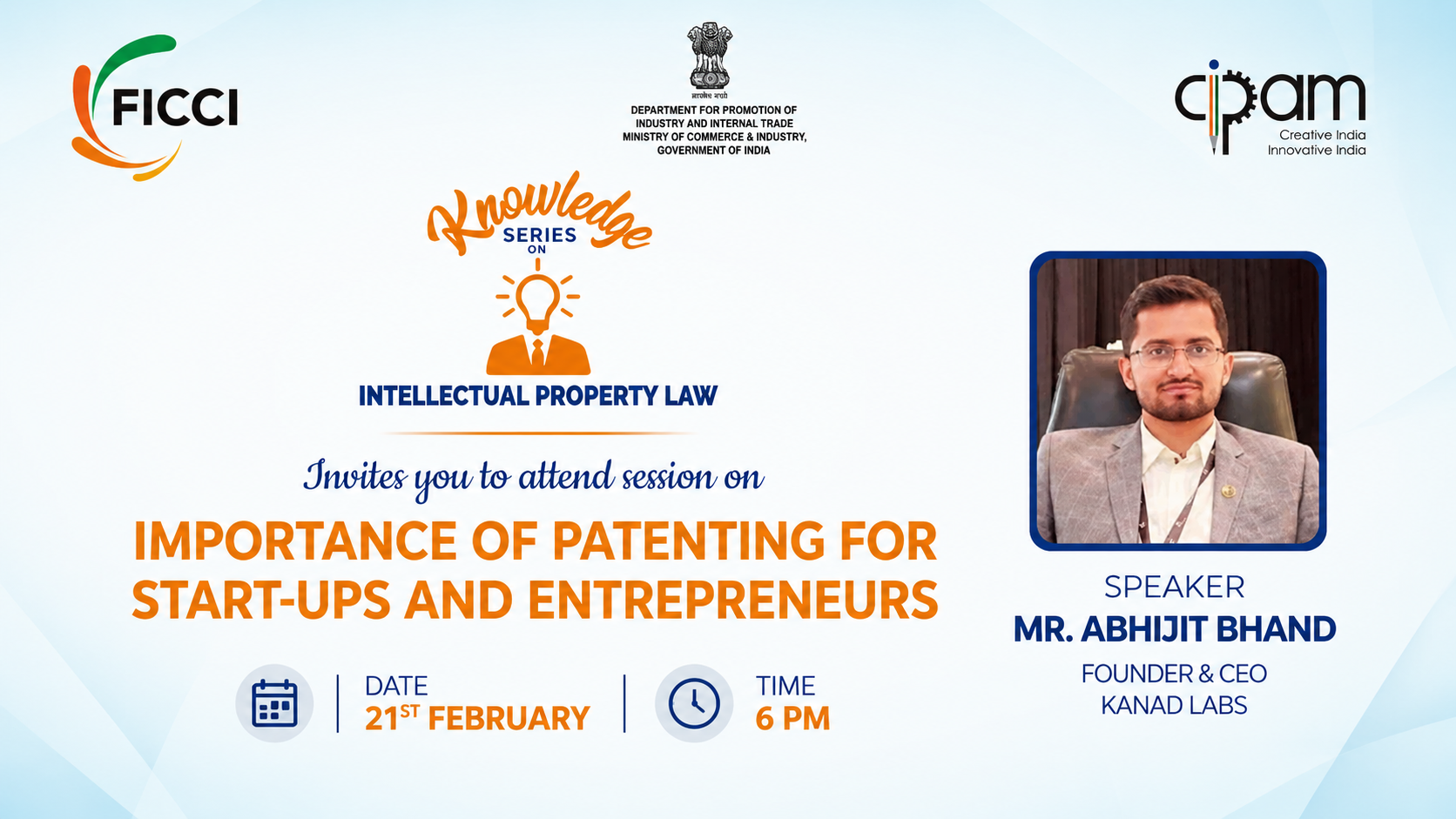
As India continues its transition towards an innovation-driven economy, intellectual property has emerged as one of the most valuable assets for startups and technology-driven enterprises. Recognizing the need to build awareness among entrepreneurs, the Federation of Indian Chambers of Commerce and Industry (FICCI), in collaboration with the Cell for IPR Promotion and Management (CIPAM), Department for Promotion of Industry and Internal Trade (DPIIT), Government of India, organized another session under its Knowledge Series on Intellectual Property Law. The webinar, titled "Importance of Patenting for Start-ups and Entrepreneurs," was delivered by Mr. Abhijit Bhand, Founder & CEO of Kanadlab Institute of Intellectual Property & Research.
The programme attracted entrepreneurs, startup founders, innovators, students, researchers, and professionals from across the country who sought to understand how patents can become strategic business tools rather than merely legal rights. Opening the session, Mr. Bhand emphasized that in today's economy, a startup's most valuable asset is often its intellectual property rather than its physical infrastructure. He remarked that successful startups are increasingly being valued on the strength of their proprietary technologies, innovative business solutions, and intellectual property portfolios.
The session explored how patents contribute to every stage of a startup's lifecycle—from attracting investors and securing government grants to facilitating technology licensing, strategic collaborations, and successful exits. Referring to India's flourishing startup ecosystem, Mr. Bhand explained that patent protection not only grants inventors exclusive rights over their innovations but also enhances credibility before venture capital firms, angel investors, incubators, and financial institutions.
A significant part of the discussion focused on Government of India's policy initiatives supporting innovation. Participants were introduced to the Startup India Action Plan, which offers startups several patent-related incentives, including up to 80% rebate on official patent filing fees, access to government-recognized patent facilitators, expedited examination of patent applications, and financial assistance for protecting intellectual property. Mr. Bhand observed that these initiatives have substantially reduced the cost and complexity of patent protection for emerging enterprises, making intellectual property more accessible than ever before.
Explaining the business rationale behind patenting, he highlighted that patents serve multiple commercial functions beyond preventing copying. They strengthen negotiation power during partnerships, improve enterprise valuation, generate licensing opportunities, support technology transfer, and create barriers to market entry for competitors. Investors, he noted, often evaluate the quality of a startup's intellectual property portfolio as an indicator of its technological capability and long-term sustainability.
The session included several examples illustrating the commercial significance of patents. Mr. Bhand referred to technology companies whose patent portfolios have become valuable corporate assets, enabling cross-licensing arrangements and providing leverage during competitive negotiations. He also discussed how pharmaceutical companies invest billions in research and development because patent protection offers a limited period of market exclusivity, allowing innovators to recover their investments while encouraging continued technological advancement.
At the same time, the webinar presented a balanced perspective by examining controversies surrounding patent protection. Participants discussed the landmark Novartis AG v. Union of India judgment, where the Supreme Court interpreted Section 3(d) of the Indian Patents Act to prevent patents on incremental pharmaceutical modifications that did not demonstrate enhanced therapeutic efficacy. The decision has become one of the most influential patent judgments globally, reinforcing India's approach of rewarding genuine innovation while preventing "evergreening" of existing patents.
The discussion also touched upon the international debate surrounding COVID-19 vaccine patents. Mr. Bhand explained how the pandemic reignited conversations regarding the balance between patent protection and public health, particularly following India's proposal at the World Trade Organization for a temporary waiver of certain TRIPS obligations relating to COVID-19 technologies. The issue demonstrated that patent law is not merely a technical legal discipline but also intersects with public policy, healthcare, economics, and international trade.
Participants were further introduced to the practical aspects of patent protection, including the three fundamental patentability requirements—novelty, inventive step, and industrial applicability. The importance of conducting prior art searches before product development, maintaining confidentiality before filing patent applications, and documenting research activities was emphasized. Entrepreneurs were advised to integrate intellectual property planning into their business strategy from the earliest stages rather than treating patents as an afterthought.
The interactive session concluded with an engaging discussion on patent commercialization, government support schemes, technology transfer, licensing strategies, and international patent filing mechanisms such as the Patent Cooperation Treaty (PCT). Participants appreciated the session for combining legal principles with practical business perspectives, making complex aspects of patent law accessible to entrepreneurs from diverse backgrounds.
The organizers noted that the webinar formed part of FICCI and CIPAM's broader efforts to strengthen intellectual property awareness across India's innovation ecosystem. As the country witnesses unprecedented growth in startups and technology-based enterprises, programmes such as these continue to play an important role in helping innovators understand that patents are not merely instruments of legal protection but strategic assets capable of driving investment, competitiveness, and long-term business success.